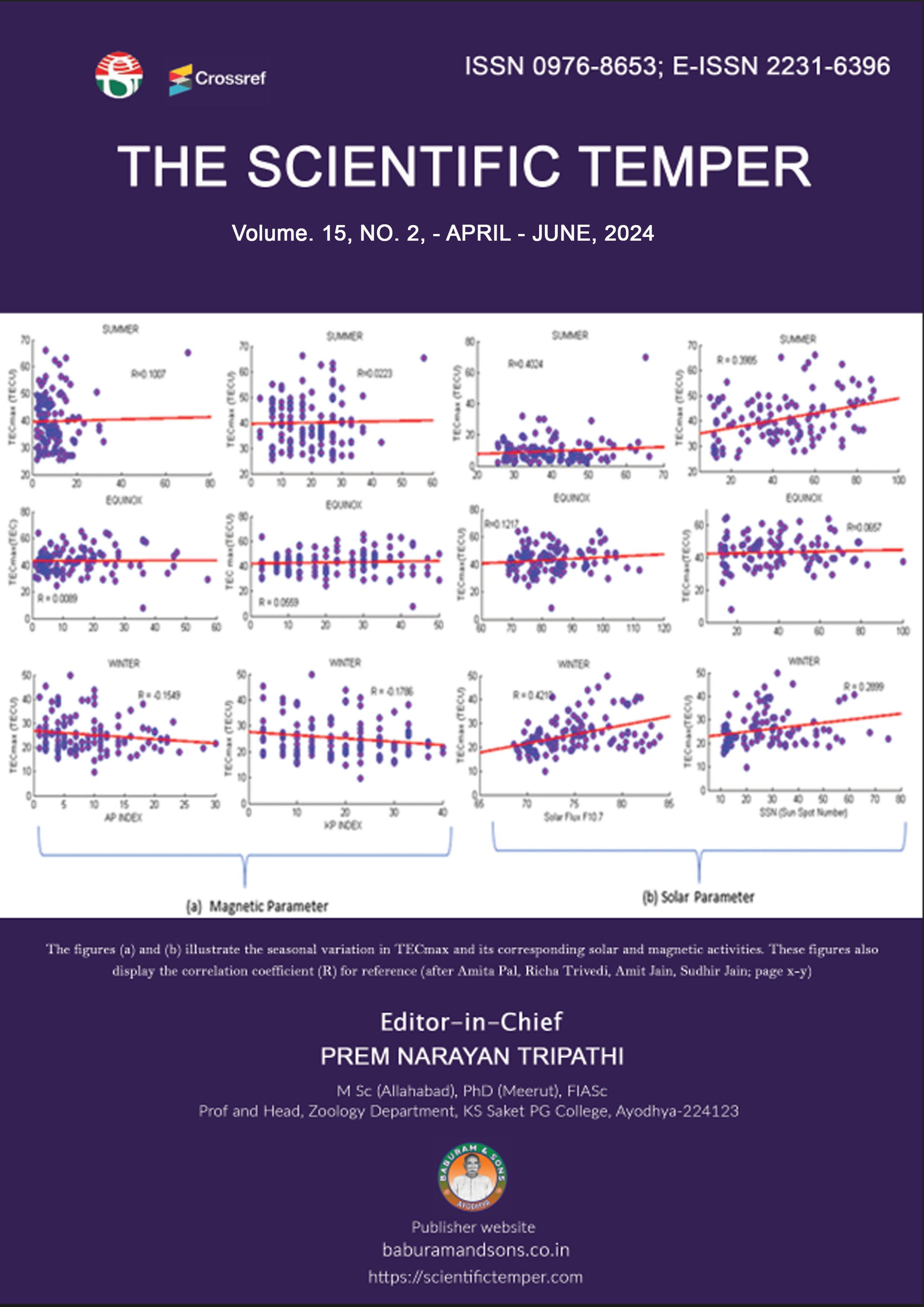
Diurnal and seasonal variation of GPS-TEC during a low solar activity period at EIA region (Bhopal)
Downloads
Published
DOI:
https://doi.org/10.58414/SCIENTIFICTEMPER.2024.15.2.16Keywords:
Keywords: Total Electron Content (TEC); Equatorial Ionization Anomaly (EIA); Global Positioning System (GPS); Solar Indices; Electron Electrojet (EEJ).Dimensions Badge
Issue
Section
License
Copyright (c) 2024 The Scientific Temper

This work is licensed under a Creative Commons Attribution-NonCommercial-ShareAlike 4.0 International License.
The ionosphere near the equatorial ionization anomaly crest region in the Indian ionospheric sector was studied from May 2016 to April 2017, a solar minimum period. Total electron content (TEC) recorded using the multiple frequency GPS receivers at Bhopal (23.2° N, 77.4° E & MLAT 14.2° N) is used for the study. The diurnal variation shows that the day minimum in TEC is attained around 06:00 hours LT, and the day maximum occurs at about 16:00 hours LT. A similar diurnal pattern was observed in all months across various seasons. During the period of study, it was observed that Seasonal variation of TEC was minimal in winter, whereas highest during equinox and summer months. The variation of TECmax with EEJ shows a positive correlation between the parameters for all the months. The highest correlation (0.8398) was observed in January 2017, while it was lowest (0.4004) in March 2017 and the results were compared with earlier observations, and a possible mechanism was discussed.Abstract
How to Cite
Downloads
Similar Articles
- Allin Joe D, Thiyagarajan Krishnan, A modified sierpinski carpet antenna structure for multiband wireless applications , The Scientific Temper: Vol. 14 No. 02 (2023): The Scientific Temper
- Leyla A.A Abu-Hussein, The role of food program to overcome obesity, overweight, and underweight among autistic children , The Scientific Temper: Vol. 14 No. 03 (2023): The Scientific Temper
- Rustam Gulomov, Khilolakhon Rakhimova, Avazbek Batoshov, Doniyor Komilov, Bioclimatic modeling of the species Phlomoides canescens (Lamiaceae) , The Scientific Temper: Vol. 14 No. 04 (2023): The Scientific Temper
- T. R. Raajpandiyan, Syed T. Hussainy, U. Rizwan, A bivariate replacement policy (T, N) under partial product process , The Scientific Temper: Vol. 15 No. 02 (2024): The Scientific Temper
- Kamna Kandpal, Piyashi Dutta, P.Sasikala Ravichandran, Examining the relationship between motivation and incentives in the context of maternal health awareness: A study of Asha workers in Uttarakhand , The Scientific Temper: Vol. 15 No. 03 (2024): The Scientific Temper
- S. Hemalatha, N. Vanjulavalli, K. Sujith, R. Surendiran, Effective gorilla troops optimization-based hierarchical clustering with HOP field neural network for intrusion detection , The Scientific Temper: Vol. 15 No. spl-1 (2024): The Scientific Temper
- Vinodini R, Ritha W, A green inventory model for deteriorating items while producing overtime with nonlinear cost and stock dependent demand , The Scientific Temper: Vol. 16 No. 01 (2025): The Scientific Temper
- Jyoti Vishwakarma, Sunil Kumar, Mapping Research on ESG Disclosure and Firm Performance: A Systematic Bibliometric Analysis , The Scientific Temper: Vol. 16 No. 09 (2025): The Scientific Temper
- ALKA SRIVASTAVA, SANJAY KUMAR, STUDY OF NUTRIENT VALUE IN POST HARVESTED INFECTED ORANGE (CITRUS SINENSIS) FRUIT , The Scientific Temper: Vol. 3 No. 1&2 (2012): The Scientific Temper
- Niharika Bharti, Photomodulation of strigolactones in mediating sunflower seedling growth , The Scientific Temper: Vol. 14 No. 02 (2023): The Scientific Temper
<< < 21 22 23 24 25 26 27 28 29 30 > >>
You may also start an advanced similarity search for this article.