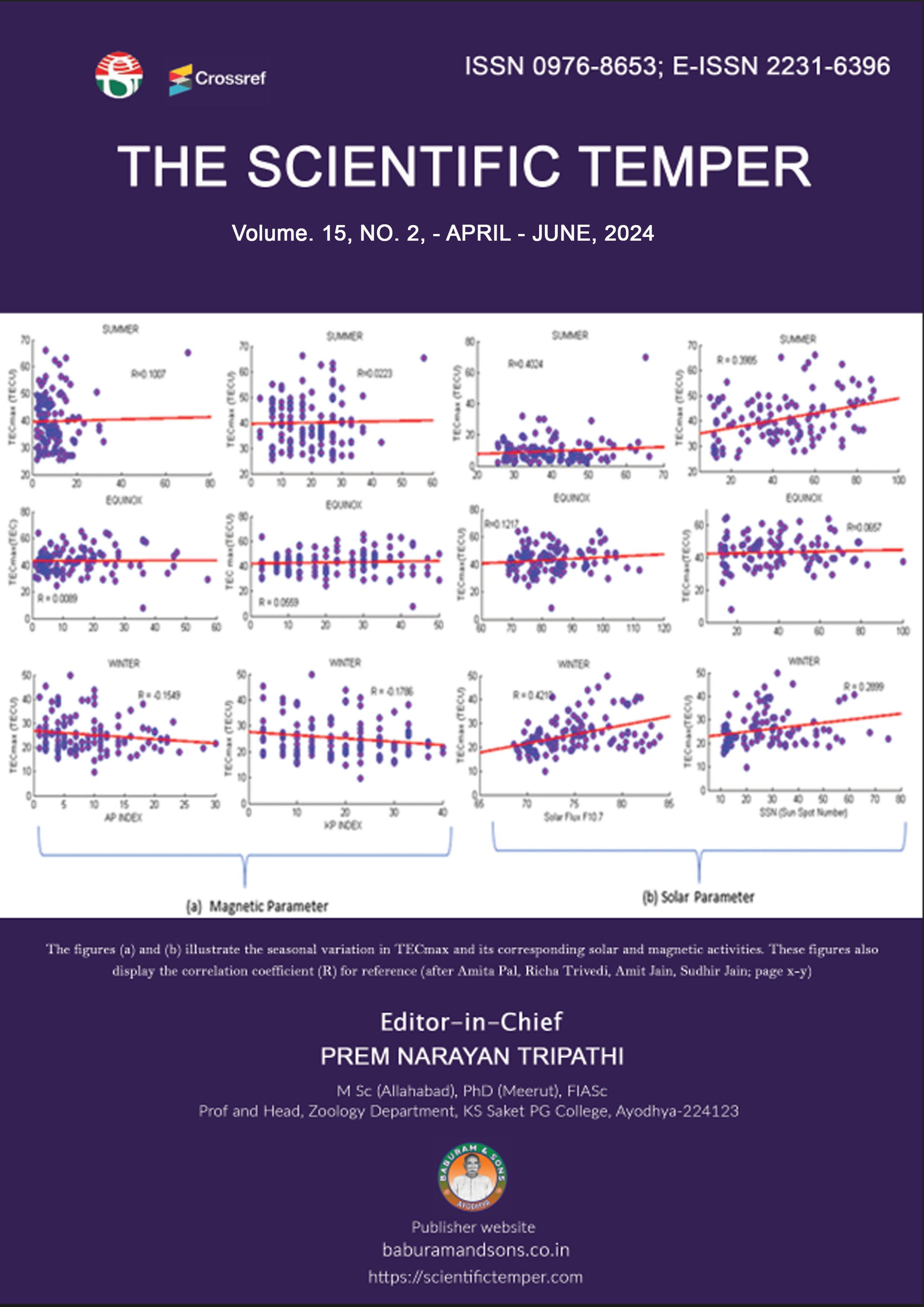
Diurnal and seasonal variation of GPS-TEC during a low solar activity period at EIA region (Bhopal)
Downloads
Published
DOI:
https://doi.org/10.58414/SCIENTIFICTEMPER.2024.15.2.16Keywords:
Keywords: Total Electron Content (TEC); Equatorial Ionization Anomaly (EIA); Global Positioning System (GPS); Solar Indices; Electron Electrojet (EEJ).Dimensions Badge
Issue
Section
License
Copyright (c) 2024 The Scientific Temper

This work is licensed under a Creative Commons Attribution-NonCommercial-ShareAlike 4.0 International License.
The ionosphere near the equatorial ionization anomaly crest region in the Indian ionospheric sector was studied from May 2016 to April 2017, a solar minimum period. Total electron content (TEC) recorded using the multiple frequency GPS receivers at Bhopal (23.2° N, 77.4° E & MLAT 14.2° N) is used for the study. The diurnal variation shows that the day minimum in TEC is attained around 06:00 hours LT, and the day maximum occurs at about 16:00 hours LT. A similar diurnal pattern was observed in all months across various seasons. During the period of study, it was observed that Seasonal variation of TEC was minimal in winter, whereas highest during equinox and summer months. The variation of TECmax with EEJ shows a positive correlation between the parameters for all the months. The highest correlation (0.8398) was observed in January 2017, while it was lowest (0.4004) in March 2017 and the results were compared with earlier observations, and a possible mechanism was discussed.Abstract
How to Cite
Downloads
Similar Articles
- ALKA SRIVASTAVA, SANJAY KUMAR, STUDY OF NUTRIENT VALUE IN POST HARVESTED INFECTED ORANGE (CITRUS SINENSIS) FRUIT , The Scientific Temper: Vol. 3 No. 1&2 (2012): The Scientific Temper
- Anjali Thapa, Yunus Ali, Sanjay Madan, Pragya Verma, Prajwal Verma, Naveen Gaurav, An Assessment of in vitro Propagation and Medicinal Properties of Datura stramonium (Dhatura) , The Scientific Temper: Vol. 13 No. 02 (2022): The Scientific Temper
- P. Pattunnarajam, Janani G, A. Vijayaraj, Sathiya Priya S, Enhanced routing strategy of wireless sensor network based on fifth generation communication technology , The Scientific Temper: Vol. 14 No. 04 (2023): The Scientific Temper
- A. Sathya, M. S. Mythili, MOHCOA: Multi-objective hermit crab optimization algorithm for feature selection in sentiment analysis of Covid-19 Twitter datasets , The Scientific Temper: Vol. 15 No. 03 (2024): The Scientific Temper
- D. Jayadurga, A. Chandrabose, Expanding the quantity of virtual machines utilized within an open-source cloud infrastructure , The Scientific Temper: Vol. 15 No. spl-1 (2024): The Scientific Temper
- Aman Bora, Ajay Kumar, Akhilesh Dwivedi, Exploring effective methods of conflict resolution: Strategies and challenges for sustainable peace , The Scientific Temper: Vol. 16 No. 06 (2025): The Scientific Temper
- Bhavya S, Prabha Lis Thomas, Effectiveness of Video Assisted Training Program on low back pain and functional disability among housekeeping employees in selected educational institutions in Bengaluru , The Scientific Temper: Vol. 16 No. 12 (2025): The Scientific Temper
- A. Kamatchi, V. Maniraj, An accurate Prediction and Classification of early Alzheimer’s Diseases using Machine Learning Algorithm , The Scientific Temper: Vol. 17 No. 03 (2026): The Scientific Temper
- Narvdeshwar Pandey, Critical Analysis of Biological Warfare , The Scientific Temper: Vol. 12 No. 1&2 (2021): The Scientific Temper
- R. P. Singh, R. Chandra, Bikrmaditya ., Effect of Nipping on Growth and Yield of Chickpea (Cicer Aritinum L.) Under Dryland Condition , The Scientific Temper: Vol. 12 No. 1&2 (2021): The Scientific Temper
<< < 22 23 24 25 26 27 28 29 30 31 > >>
You may also start an advanced similarity search for this article.