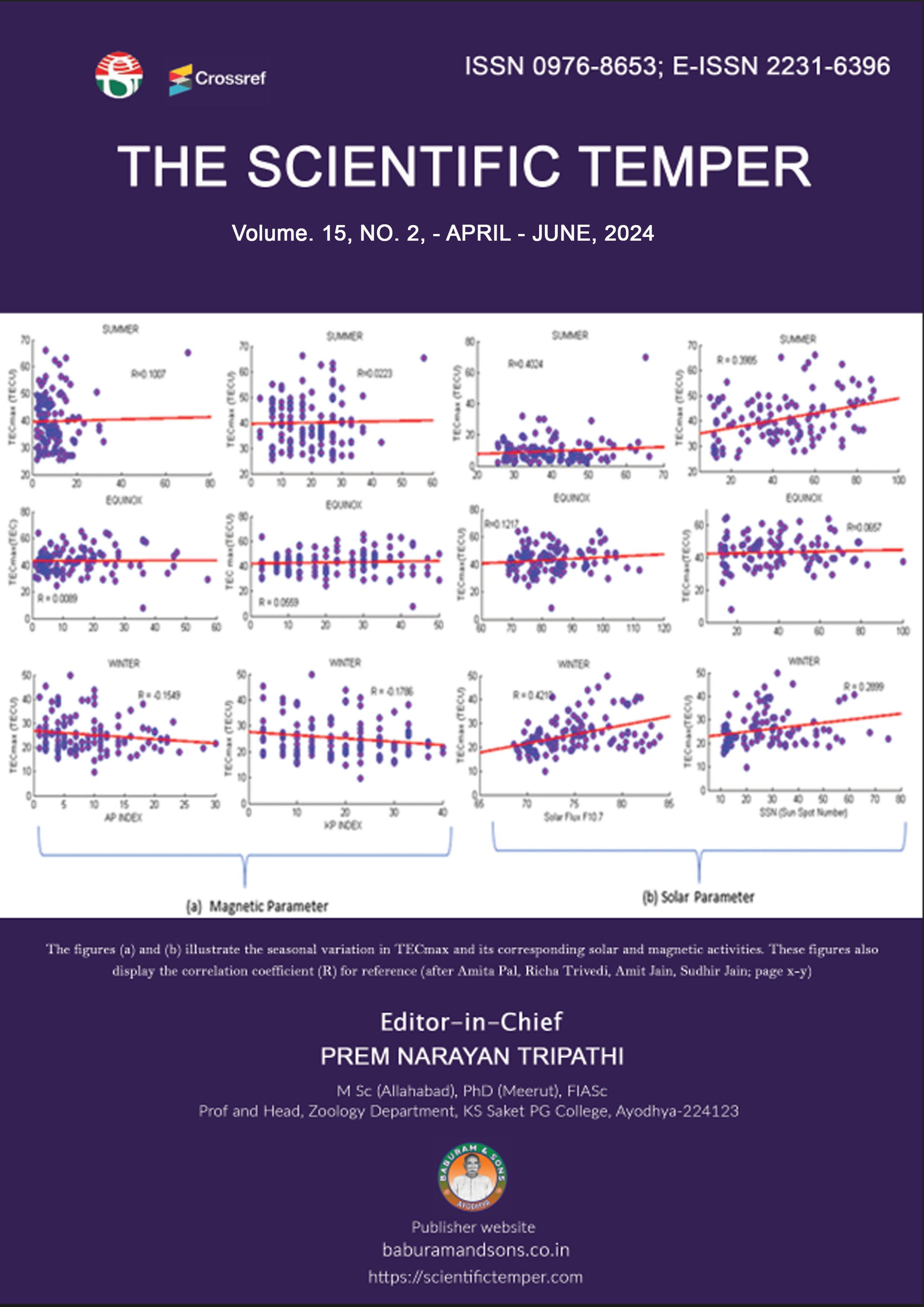
Diurnal and seasonal variation of GPS-TEC during a low solar activity period at EIA region (Bhopal)
Downloads
Published
DOI:
https://doi.org/10.58414/SCIENTIFICTEMPER.2024.15.2.16Keywords:
Keywords: Total Electron Content (TEC); Equatorial Ionization Anomaly (EIA); Global Positioning System (GPS); Solar Indices; Electron Electrojet (EEJ).Dimensions Badge
Issue
Section
License
Copyright (c) 2024 The Scientific Temper

This work is licensed under a Creative Commons Attribution-NonCommercial-ShareAlike 4.0 International License.
The ionosphere near the equatorial ionization anomaly crest region in the Indian ionospheric sector was studied from May 2016 to April 2017, a solar minimum period. Total electron content (TEC) recorded using the multiple frequency GPS receivers at Bhopal (23.2° N, 77.4° E & MLAT 14.2° N) is used for the study. The diurnal variation shows that the day minimum in TEC is attained around 06:00 hours LT, and the day maximum occurs at about 16:00 hours LT. A similar diurnal pattern was observed in all months across various seasons. During the period of study, it was observed that Seasonal variation of TEC was minimal in winter, whereas highest during equinox and summer months. The variation of TECmax with EEJ shows a positive correlation between the parameters for all the months. The highest correlation (0.8398) was observed in January 2017, while it was lowest (0.4004) in March 2017 and the results were compared with earlier observations, and a possible mechanism was discussed.Abstract
How to Cite
Downloads
Similar Articles
- Tulika ., EFFECT OF FURADAN ON HAEMATOLOGY OF Channa punctatus (BLOCH) IN CULTURE MEDIUM UNDER LABORATORY CONDITIONS , The Scientific Temper: Vol. 9 No. 1&2 (2018): The Scientific Temper
- R. P. Singh, R. Chandra, Bikrmaditya ., Effect of Nipping on Growth and Yield of Chickpea (Cicer Aritinum L.) Under Dryland Condition , The Scientific Temper: Vol. 12 No. 1&2 (2021): The Scientific Temper
- B. R. Jaipal, Himmat Singh, Nesting and distribution pattern of house crow (Corvus splendens) in Western Rajasthan, India , The Scientific Temper: Vol. 14 No. 02 (2023): The Scientific Temper
- Sawitri Devi, Raj Kumar, Unveiling scholarly insights: A bibliometric analysis of literature on gender bias at the workplace , The Scientific Temper: Vol. 15 No. 03 (2024): The Scientific Temper
- Jayshree Mehta, Pranjal Bhatt, Vikas Raval, Skill development in India: Challenges, current, and future perspectives , The Scientific Temper: Vol. 15 No. spl-2 (2024): The Scientific Temper
- M. Deepika, I Antonitte Vinoline, Optimization of an Advanced Integrated Inventory Model Considering Shortages and Deterioration across Varying Demand Functions , The Scientific Temper: Vol. 16 No. 09 (2025): The Scientific Temper
- Sweta Sain, Nilima Kumari, BN Tripathi, TRADITIONAL USES OF LOCALLY AVAILABLE PLANTS FOR THE TREATMENT OF URINARY DISORDERS AT BANASTHALI REGION OF RAJASTHAN, INDIA , The Scientific Temper: Vol. 8 No. 1&2 (2017): The Scientific Temper
- Shaik Rubeena Yasmin, Yashodhara Verma, Reena Lawrence, Biowaste-derived Nanoparticles and Their Preparation: A Review , The Scientific Temper: Vol. 12 No. 1&2 (2021): The Scientific Temper
- G. Deena, K. Raja, M. Azhagiri, W.A. Breen, S. Prema, Application of support vector classifier for mango leaf disease classification , The Scientific Temper: Vol. 14 No. 04 (2023): The Scientific Temper
- T. Malathi, T. Dheepak, Enhanced regression method for weather forecasting , The Scientific Temper: Vol. 15 No. spl-1 (2024): The Scientific Temper
<< < 23 24 25 26 27 28 29 30 31 32 > >>
You may also start an advanced similarity search for this article.