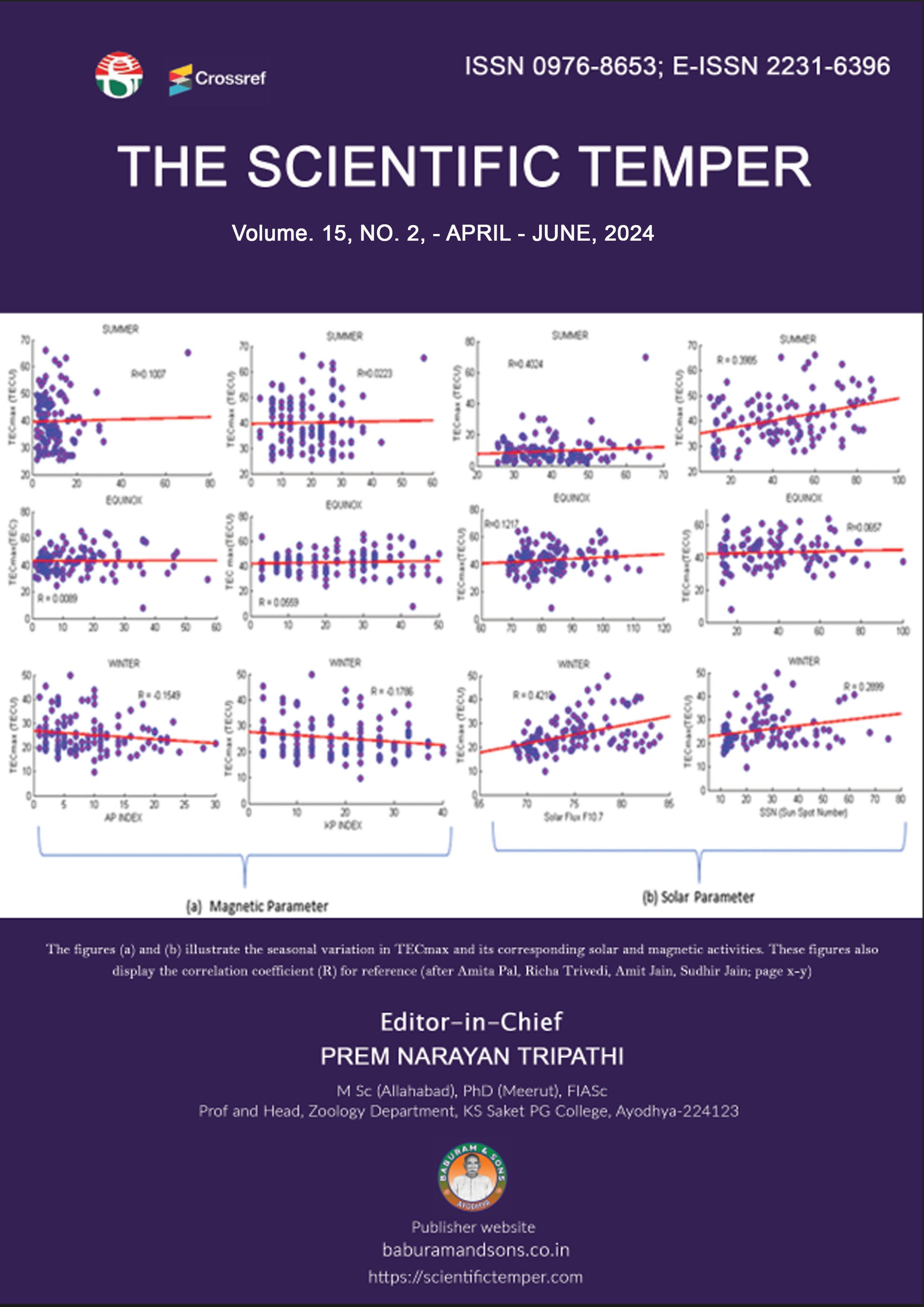
Diurnal and seasonal variation of GPS-TEC during a low solar activity period at EIA region (Bhopal)
Downloads
Published
DOI:
https://doi.org/10.58414/SCIENTIFICTEMPER.2024.15.2.16Keywords:
Keywords: Total Electron Content (TEC); Equatorial Ionization Anomaly (EIA); Global Positioning System (GPS); Solar Indices; Electron Electrojet (EEJ).Dimensions Badge
Issue
Section
License
Copyright (c) 2024 The Scientific Temper

This work is licensed under a Creative Commons Attribution-NonCommercial-ShareAlike 4.0 International License.
The ionosphere near the equatorial ionization anomaly crest region in the Indian ionospheric sector was studied from May 2016 to April 2017, a solar minimum period. Total electron content (TEC) recorded using the multiple frequency GPS receivers at Bhopal (23.2° N, 77.4° E & MLAT 14.2° N) is used for the study. The diurnal variation shows that the day minimum in TEC is attained around 06:00 hours LT, and the day maximum occurs at about 16:00 hours LT. A similar diurnal pattern was observed in all months across various seasons. During the period of study, it was observed that Seasonal variation of TEC was minimal in winter, whereas highest during equinox and summer months. The variation of TECmax with EEJ shows a positive correlation between the parameters for all the months. The highest correlation (0.8398) was observed in January 2017, while it was lowest (0.4004) in March 2017 and the results were compared with earlier observations, and a possible mechanism was discussed.Abstract
How to Cite
Downloads
Similar Articles
- Sweta Sain, Nilima Kumari, BN Tripathi, TRADITIONAL USES OF LOCALLY AVAILABLE PLANTS FOR THE TREATMENT OF URINARY DISORDERS AT BANASTHALI REGION OF RAJASTHAN, INDIA , The Scientific Temper: Vol. 8 No. 1&2 (2017): The Scientific Temper
- Shaik Rubeena Yasmin, Yashodhara Verma, Reena Lawrence, Biowaste-derived Nanoparticles and Their Preparation: A Review , The Scientific Temper: Vol. 12 No. 1&2 (2021): The Scientific Temper
- Ashutosh Kumar, The Effect of Noise Exposure on Cognitive Performance and Brain Activity Patterns , The Scientific Temper: Vol. 12 No. 1&2 (2021): The Scientific Temper
- NITHYA R, shruthi D, Sindhuja S, Sneha S, Challenges encountered by health care professionals in monitoring adverse events due to medical devices: A review , The Scientific Temper: Vol. 14 No. 02 (2023): The Scientific Temper
- Temesgen A. Asfaw, Batch size impact on enset leaf disease detection , The Scientific Temper: Vol. 15 No. 01 (2024): The Scientific Temper
- Sabeerath K, Manikandasaran S. Sundaram, BTEDD: Block-level tokens for efficient data deduplication in public cloud infrastructures , The Scientific Temper: Vol. 15 No. 03 (2024): The Scientific Temper
- M. Menaha, J. Lavanya, Crop yield prediction in diverse environmental conditions using ensemble learning , The Scientific Temper: Vol. 15 No. 03 (2024): The Scientific Temper
- Harsh Mineshbhai Shah, A literature-based analysis of studies in urban landscape concept , The Scientific Temper: Vol. 15 No. spl-2 (2024): The Scientific Temper
- Mayur Vyas, Piyush Mehta, The sentimental and financial journey of women navigating e-commerce , The Scientific Temper: Vol. 16 No. Spl-1 (2025): The Scientific Temper
- Priya Sharma, Jyoti Rana, Understanding Customer Awareness and effectiveness of Social Media Marketing in Banks , The Scientific Temper: Vol. 16 No. 09 (2025): The Scientific Temper
<< < 24 25 26 27 28 29 30 31 32 33 > >>
You may also start an advanced similarity search for this article.