Diurnal and seasonal variation of GPS-TEC during a low solar activity period at EIA region (Bhopal)
Downloads
Published
DOI:
https://doi.org/10.58414/SCIENTIFICTEMPER.2024.15.2.16Keywords:
Keywords: Total Electron Content (TEC); Equatorial Ionization Anomaly (EIA); Global Positioning System (GPS); Solar Indices; Electron Electrojet (EEJ).Dimensions Badge
Issue
Section
License
Copyright (c) 2024 The Scientific Temper

This work is licensed under a Creative Commons Attribution-NonCommercial-ShareAlike 4.0 International License.
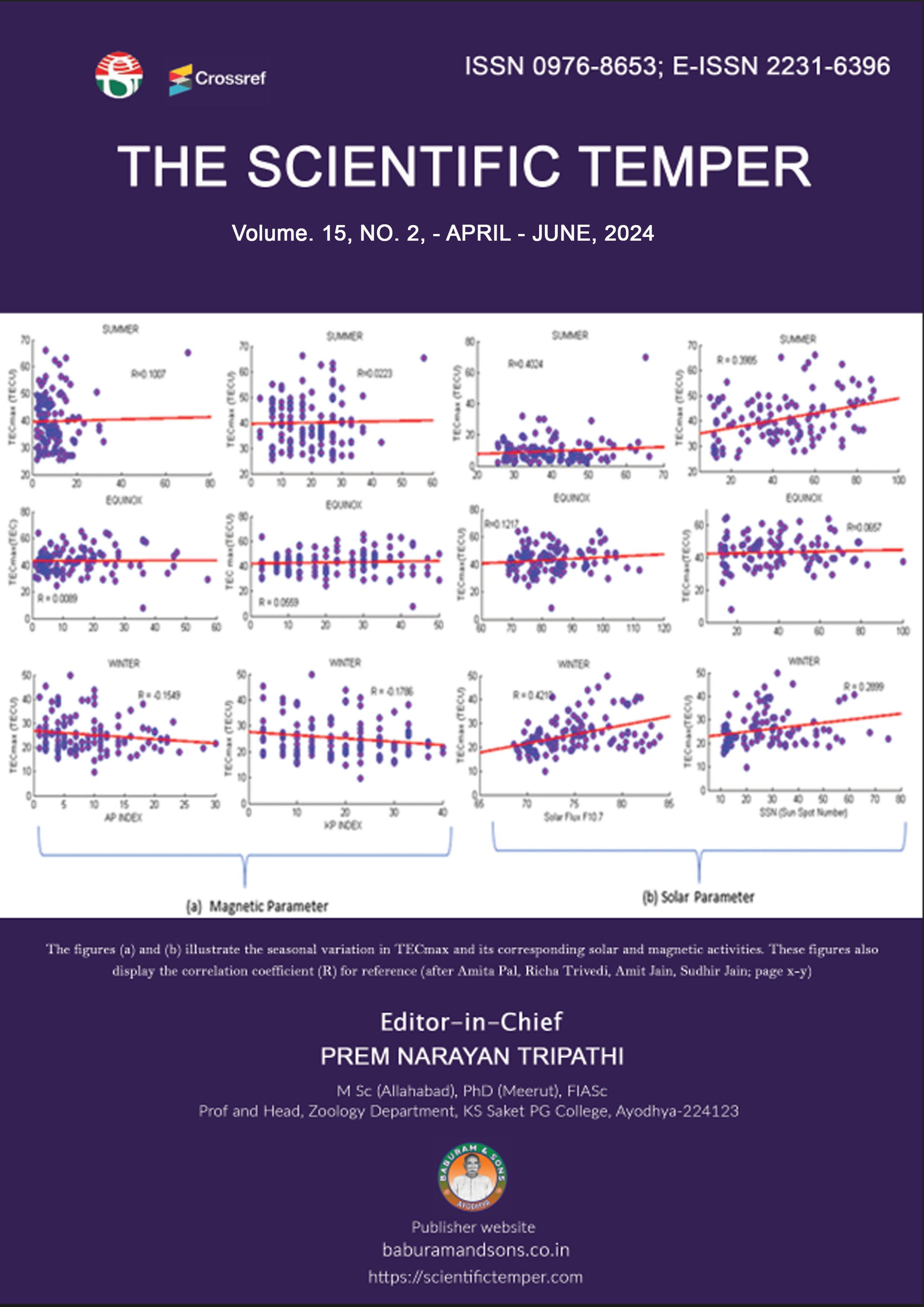
The ionosphere near the equatorial ionization anomaly crest region in the Indian ionospheric sector was studied from May 2016 to April 2017, a solar minimum period. Total electron content (TEC) recorded using the multiple frequency GPS receivers at Bhopal (23.2° N, 77.4° E & MLAT 14.2° N) is used for the study. The diurnal variation shows that the day minimum in TEC is attained around 06:00 hours LT, and the day maximum occurs at about 16:00 hours LT. A similar diurnal pattern was observed in all months across various seasons. During the period of study, it was observed that Seasonal variation of TEC was minimal in winter, whereas highest during equinox and summer months. The variation of TECmax with EEJ shows a positive correlation between the parameters for all the months. The highest correlation (0.8398) was observed in January 2017, while it was lowest (0.4004) in March 2017 and the results were compared with earlier observations, and a possible mechanism was discussed.Abstract
How to Cite
Downloads
Similar Articles
- NITHYA R, shruthi D, Sindhuja S, Sneha S, Challenges encountered by health care professionals in monitoring adverse events due to medical devices: A review , The Scientific Temper: Vol. 14 No. 02 (2023): The Scientific Temper
- Temesgen A. Asfaw, Batch size impact on enset leaf disease detection , The Scientific Temper: Vol. 15 No. 01 (2024): The Scientific Temper
- A. Jabeen, A. R. M. Shanavas, Hazard regressive multipoint elitist spiral search optimization for resource efficient task scheduling in cloud computing , The Scientific Temper: Vol. 15 No. 02 (2024): The Scientific Temper
- O. Devipriya, K. Kungumaraj, Enhancing cloud efficiency: an intelligent virtual machine selection and migration approach for VM consolidation , The Scientific Temper: Vol. 15 No. spl-1 (2024): The Scientific Temper
- Kshema Manu, Malathi S, A Comprehensive Study on Addressing Trust Erosion in Multimedia in The Indian Context , The Scientific Temper: Vol. 16 No. 03 (2025): The Scientific Temper
- Y. Mohammed Iqbal, M. Mohamed Surputheen, S. Peerbasha, A COVID Net-predictor: A multi-head CNN and LSTM-based deep learning framework for COVID-19 diagnosis , The Scientific Temper: Vol. 16 No. 03 (2025): The Scientific Temper
- Merina Yasmin, Chaitali Kundu, Monalisha Paul, Sandip Kumar Sinha, Ameliorative efficacy of aqueous extract of clove bud (AEC) against smokeless tobacco product induced antioxidative damages: An experimental study on male albino rat , The Scientific Temper: Vol. 16 No. 05 (2025): The Scientific Temper
- S. Jerinrechal, I. Antonitte Vinoline, A Deterministic Inventory Model with Automation-Enabled Processes for Defective Item Management , The Scientific Temper: Vol. 16 No. 11 (2025): The Scientific Temper
- Anil Kumar, Niranjan Kumar Mishra, Rishav Raj, Pearson Correlation Study of Selected Soil Samples of the Eastern Region of Deoghar (PCSSSSERD) , The Scientific Temper: Vol. 17 No. 02 (2026): The Scientific Temper
- Rohit Mittal, Devinder Kumar, Harmel Singh Chahal, Antioxidant and Free Radical Scavenging Activity of Methanolic Extract of (Hordeum vulgare) Barley , The Scientific Temper: Vol. 13 No. 02 (2022): The Scientific Temper
<< < 25 26 27 28 29 30 31 32 33 34 > >>
You may also start an advanced similarity search for this article.