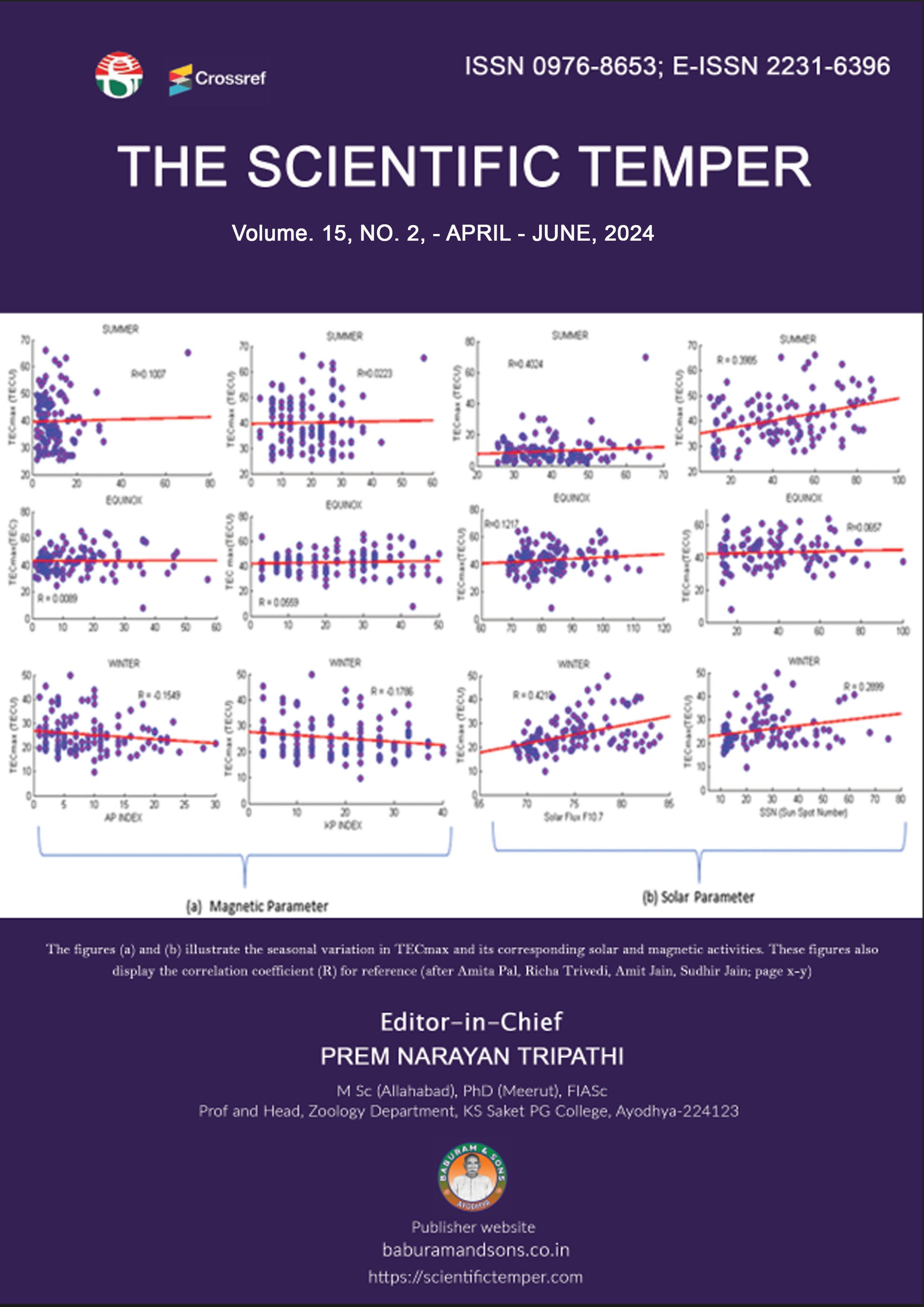
Diurnal and seasonal variation of GPS-TEC during a low solar activity period at EIA region (Bhopal)
Downloads
Published
DOI:
https://doi.org/10.58414/SCIENTIFICTEMPER.2024.15.2.16Keywords:
Keywords: Total Electron Content (TEC); Equatorial Ionization Anomaly (EIA); Global Positioning System (GPS); Solar Indices; Electron Electrojet (EEJ).Dimensions Badge
Issue
Section
License
Copyright (c) 2024 The Scientific Temper

This work is licensed under a Creative Commons Attribution-NonCommercial-ShareAlike 4.0 International License.
The ionosphere near the equatorial ionization anomaly crest region in the Indian ionospheric sector was studied from May 2016 to April 2017, a solar minimum period. Total electron content (TEC) recorded using the multiple frequency GPS receivers at Bhopal (23.2° N, 77.4° E & MLAT 14.2° N) is used for the study. The diurnal variation shows that the day minimum in TEC is attained around 06:00 hours LT, and the day maximum occurs at about 16:00 hours LT. A similar diurnal pattern was observed in all months across various seasons. During the period of study, it was observed that Seasonal variation of TEC was minimal in winter, whereas highest during equinox and summer months. The variation of TECmax with EEJ shows a positive correlation between the parameters for all the months. The highest correlation (0.8398) was observed in January 2017, while it was lowest (0.4004) in March 2017 and the results were compared with earlier observations, and a possible mechanism was discussed.Abstract
How to Cite
Downloads
Similar Articles
- V. K. Goswami, Pigeonpea (Cajanus cajan L.) growth and yield with varying spacing and fertilizer , The Scientific Temper: Vol. 14 No. 03 (2023): The Scientific Temper
- Aruljothi Rajasekaran, Jemima Priyadarsini R., ECDS: Enhanced Cloud Data Security Technique to Protect Data Being Stored in Cloud Infrastructure , The Scientific Temper: Vol. 15 No. 04 (2024): The Scientific Temper
- R. Thiagarajan, S. Prakash Kumar, Performance of public transport appraisal using machine learning , The Scientific Temper: Vol. 15 No. spl-1 (2024): The Scientific Temper
- M.S. Rajani Kanth, Surabhi Ramadevi, P. Guru Murthy, Liberation through the sound and silence: The AUM , The Scientific Temper: Vol. 16 No. Spl-1 (2025): The Scientific Temper
- Kumar Kapil, Chaudhary Sachin, Malik P. V., BIOACCUMULATION OF HEAVY METALS IN ORGANS OF FRESH WATER FISH CLARIAS BATRACHUS (MANGUR) , The Scientific Temper: Vol. 1 No. 01 (2010): The Scientific Temper
- Kumar Sanu, Equabal Jawaid, POND EUTROPHICATION AND FOOD TYPE AS DETERMINANT OF GROWTH AND SURVIVAL IN Clarias batrachus (LINN.) , The Scientific Temper: Vol. 9 No. 1&2 (2018): The Scientific Temper
- B.P. Singh, Manju Yadav, Afforestation and Economic Upgradation of Wastelands Reclamation in Ganga-Yamuna Doab , The Scientific Temper: Vol. 12 No. 1&2 (2021): The Scientific Temper
- Raja Selvaraj, Manikandasaran S. Sundari, EAM: Enhanced authentication method to ensure the authenticity and integrity of the data in VM migration to the cloud environment , The Scientific Temper: Vol. 14 No. 01 (2023): The Scientific Temper
- Sheena Edavalath, Manikandasaran S. Sundaram, MARCR: Method of allocating resources based on cost of the resources in a heterogeneous cloud environment , The Scientific Temper: Vol. 14 No. 03 (2023): The Scientific Temper
- C. Agilan, Lakshna Arun, Optimization-based clustering feature extraction approach for human emotion recognition , The Scientific Temper: Vol. 15 No. spl-1 (2024): The Scientific Temper
<< < 26 27 28 29 30 31 32 33 34 35 > >>
You may also start an advanced similarity search for this article.