Diurnal and seasonal variation of GPS-TEC during a low solar activity period at EIA region (Bhopal)
Downloads
Published
DOI:
https://doi.org/10.58414/SCIENTIFICTEMPER.2024.15.2.16Keywords:
Keywords: Total Electron Content (TEC); Equatorial Ionization Anomaly (EIA); Global Positioning System (GPS); Solar Indices; Electron Electrojet (EEJ).Dimensions Badge
Issue
Section
License
Copyright (c) 2024 The Scientific Temper

This work is licensed under a Creative Commons Attribution-NonCommercial-ShareAlike 4.0 International License.
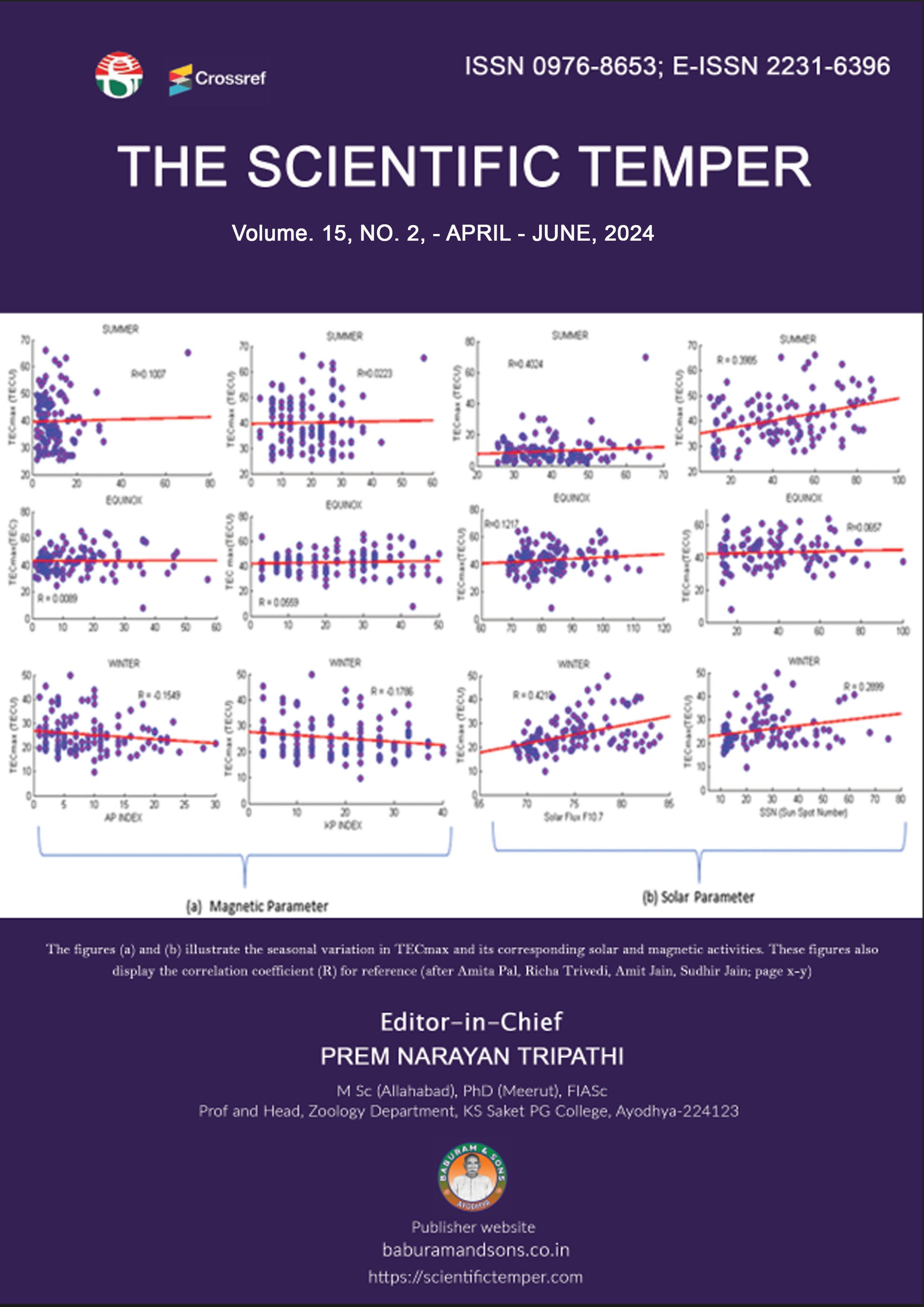
The ionosphere near the equatorial ionization anomaly crest region in the Indian ionospheric sector was studied from May 2016 to April 2017, a solar minimum period. Total electron content (TEC) recorded using the multiple frequency GPS receivers at Bhopal (23.2° N, 77.4° E & MLAT 14.2° N) is used for the study. The diurnal variation shows that the day minimum in TEC is attained around 06:00 hours LT, and the day maximum occurs at about 16:00 hours LT. A similar diurnal pattern was observed in all months across various seasons. During the period of study, it was observed that Seasonal variation of TEC was minimal in winter, whereas highest during equinox and summer months. The variation of TECmax with EEJ shows a positive correlation between the parameters for all the months. The highest correlation (0.8398) was observed in January 2017, while it was lowest (0.4004) in March 2017 and the results were compared with earlier observations, and a possible mechanism was discussed.Abstract
How to Cite
Downloads
Similar Articles
- S. Ramkumar, K. Aanandha Saravanan, Martin Joel Rathnam, M. Revathy, Integration of AI and agent-based modeling for simulating human-ecological systems , The Scientific Temper: Vol. 16 No. 03 (2025): The Scientific Temper
- K. Gokulkannan, M. Parthiban, Jayanthi S, Manoj Kumar T, Cost effective cloud-based data storage scheme with enhanced privacy preserving principles , The Scientific Temper: Vol. 15 No. 02 (2024): The Scientific Temper
- Abu Regasa, Habtamu Rufe, Synergistic Amelioration of Acidic Soils: A Review of Integrated Lime, Organic, and Inorganic Fertilizer Strategies , The Scientific Temper: Vol. 17 No. 02 (2026): The Scientific Temper
- F. Mohammed Arshad, K. Sharmila, Enhanced Stroke Risk Prediction Through Optuna-Based Hyperparameter Optimization and Ensemble Classification Models , The Scientific Temper: Vol. 17 No. 05 (2026): The Scientific Temper
- SOBTI R.C., KIRTIPAL N., THAKUR H., JANMEJA A.K., POLYMORPHISM IN INTERLEUKIN-4 GENE AND THE RISK OF CHRONIC OBSTRUCTIVE PULMONARY DISEASE IN A NORTH INDIAN POPULATION : A CASE-CONTROL STUDY , The Scientific Temper: Vol. 2 No. 1&2 (2011): The Scientific Temper
- Anita Yadav, Neerja Kapoor, Shivji Malviya, Sandeep K. Malhotra, COVID-19 Pandemic and the Global Vaccine Strategy , The Scientific Temper: Vol. 11 No. 1&2 (2020): The Scientific Temper
- Archana Bansal, Management of Crop-Residue to Control Environmental Hazards , The Scientific Temper: Vol. 13 No. 02 (2022): The Scientific Temper
- Royan Chhetri, Prem Kumar N, Polyphenolic compounds as novel reno-modulatory agents in the management of diabetic nephropathy in Wistar rats , The Scientific Temper: Vol. 15 No. 04 (2024): The Scientific Temper
- D. Selvaraj, A study on sustainable technology development of fintech 5.0 in Indian industries , The Scientific Temper: Vol. 16 No. Spl-2 (2025): The Scientific Temper
- Tarandeep Kaur, Sangeeta Taneja, Kashmiri Embroidery: Sustaining Cultural Heritage in a Globalized World , The Scientific Temper: Vol. 16 No. 10 (2025): The Scientific Temper
<< < 17 18 19 20 21 22 23 24 25 26 > >>
You may also start an advanced similarity search for this article.