Diurnal and seasonal variation of GPS-TEC during a low solar activity period at EIA region (Bhopal)
Downloads
Published
DOI:
https://doi.org/10.58414/SCIENTIFICTEMPER.2024.15.2.16Keywords:
Keywords: Total Electron Content (TEC); Equatorial Ionization Anomaly (EIA); Global Positioning System (GPS); Solar Indices; Electron Electrojet (EEJ).Dimensions Badge
Issue
Section
License
Copyright (c) 2024 The Scientific Temper

This work is licensed under a Creative Commons Attribution-NonCommercial-ShareAlike 4.0 International License.
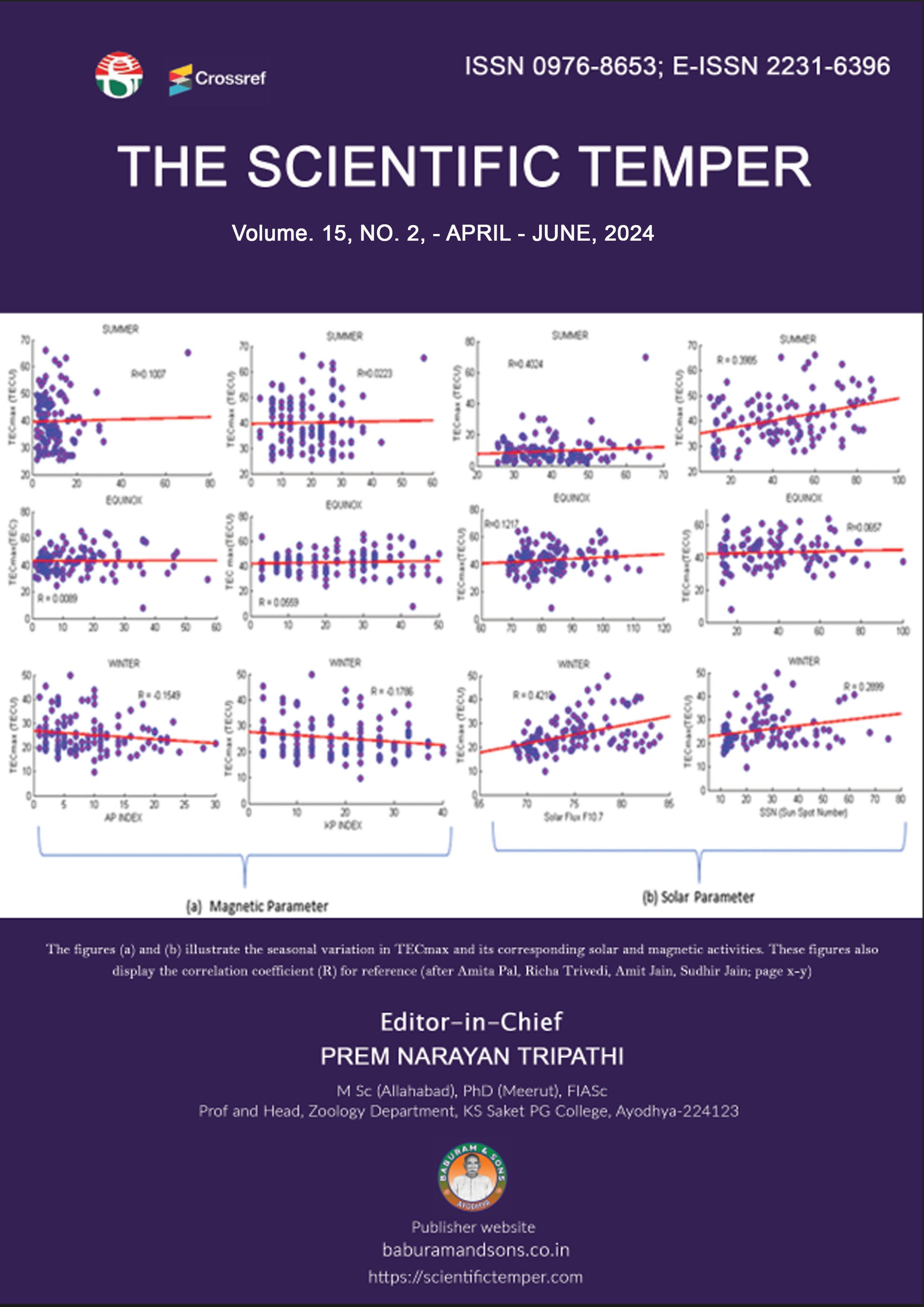
The ionosphere near the equatorial ionization anomaly crest region in the Indian ionospheric sector was studied from May 2016 to April 2017, a solar minimum period. Total electron content (TEC) recorded using the multiple frequency GPS receivers at Bhopal (23.2° N, 77.4° E & MLAT 14.2° N) is used for the study. The diurnal variation shows that the day minimum in TEC is attained around 06:00 hours LT, and the day maximum occurs at about 16:00 hours LT. A similar diurnal pattern was observed in all months across various seasons. During the period of study, it was observed that Seasonal variation of TEC was minimal in winter, whereas highest during equinox and summer months. The variation of TECmax with EEJ shows a positive correlation between the parameters for all the months. The highest correlation (0.8398) was observed in January 2017, while it was lowest (0.4004) in March 2017 and the results were compared with earlier observations, and a possible mechanism was discussed.Abstract
How to Cite
Downloads
Similar Articles
- Brigith Gladys L, Merline Vinotha J, Sustainable fuzzy rough multi-objective multi-route cold transportation model with traffic flow and route constraints , The Scientific Temper: Vol. 16 No. 01 (2025): The Scientific Temper
- Nagendra Kumar Yadav, PESTICIDE TOXICITY AND BIOCHEMICAL CHANGES IN FRESHWATER FISHES , The Scientific Temper: Vol. 9 No. 1&2 (2018): The Scientific Temper
- Anurag Tripathi, Histoenzymological Distribution of Acetylcholinesterase in the Rostral Mesencephalic Torus Semicircularis and Tegmental Nuclei of an Indian air Breathing Teleost Heteropneustes fossilis , The Scientific Temper: Vol. 12 No. 1&2 (2021): The Scientific Temper
- Naveen Kumar, Sunder S. Arya, Mamta Sawariya, Ajay Kumar, Neha Yadav, Jyoti Sharma, Himanshu Mehra, Unraveling the effect of salicylic acid on Vigna radiata L. under PEG- induced drought stress , The Scientific Temper: Vol. 14 No. 04 (2023): The Scientific Temper
- Shemal Dave, Dhaval Vyas, Jyotindra Jani, Capital adequacy and systemic risk: Evidence from selected Indian private sector banks , The Scientific Temper: Vol. 15 No. spl-2 (2024): The Scientific Temper
- Madhuri Prashant Pant, Jayshri Appaso Patil, Unlocking the potential of big data and analytics significance, applications in diverse domains and implementation of Apache Hadoop map/reduce for citation histogram , The Scientific Temper: Vol. 16 No. Spl-2 (2025): The Scientific Temper
- Mohanapriya Jayapal, Hema Jagadeesan, Plant-microbe-dye interaction during rhizoremediation , The Scientific Temper: Vol. 14 No. 01 (2023): The Scientific Temper
- Sangeeta Modi, P Usha, Fault analysis in hybrid microgrid for developing a suitable protection scheme , The Scientific Temper: Vol. 14 No. 01 (2023): The Scientific Temper
- D. Prabakar, Santhosh Kumar D.R., R.S. Kumar, Chitra M., Somasundaram K., S.D.P. Ragavendiran, Narayan K. Vyas, Task offloading and trajectory control techniques in unmanned aerial vehicles with Internet of Things – An exhaustive review , The Scientific Temper: Vol. 14 No. 04 (2023): The Scientific Temper
- Chaitanya A. Kulkarni, Sayali Wadhokar, Om C. Wadhokar, Medhavi Joshi, Tushar Palekar, The intersection of cervical cancer treatment and physiotherapy: Current insights and future directions , The Scientific Temper: Vol. 15 No. 04 (2024): The Scientific Temper
<< < 18 19 20 21 22 23 24 25 26 27 > >>
You may also start an advanced similarity search for this article.