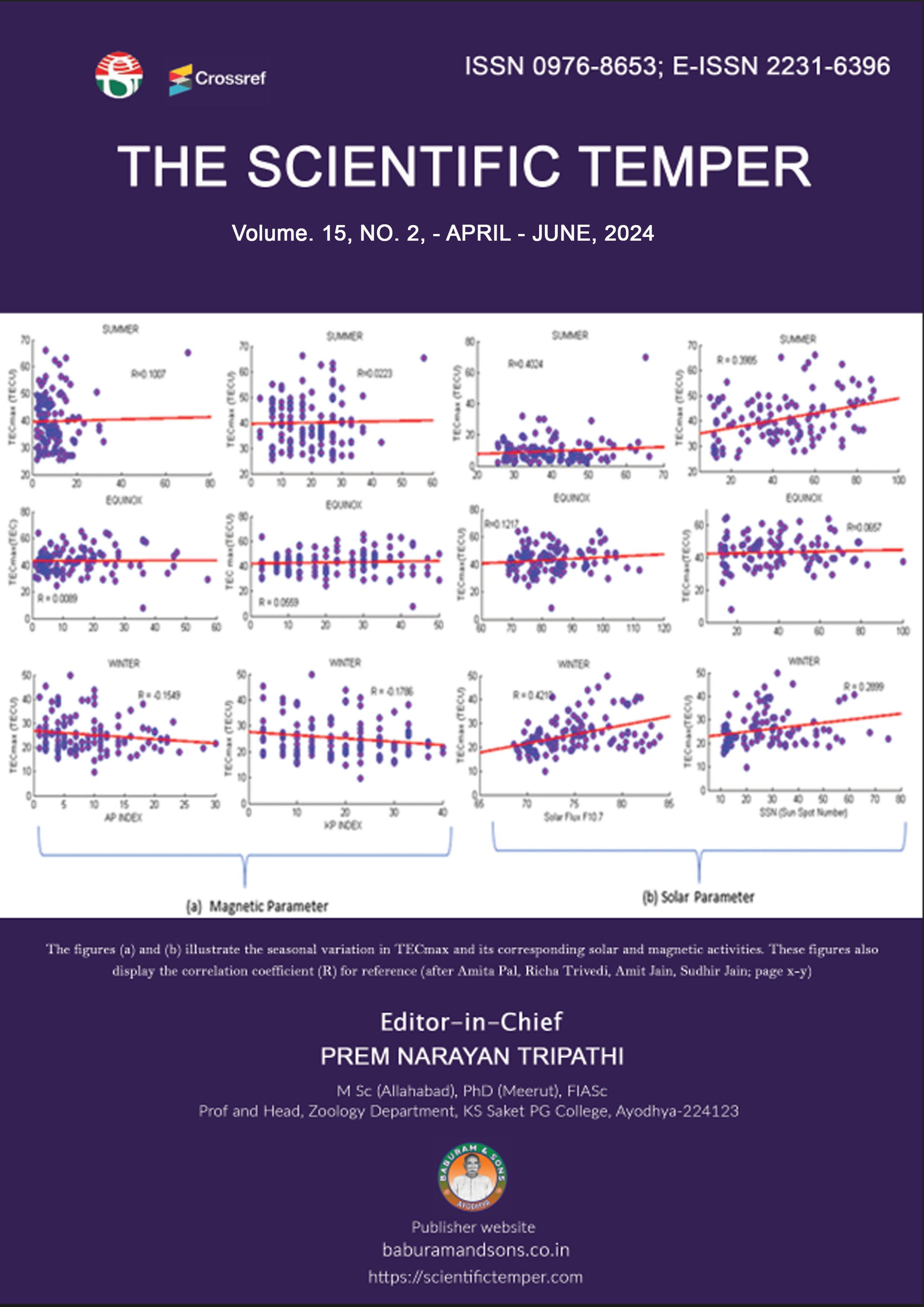
Diurnal and seasonal variation of GPS-TEC during a low solar activity period at EIA region (Bhopal)
Downloads
Published
DOI:
https://doi.org/10.58414/SCIENTIFICTEMPER.2024.15.2.16Keywords:
Keywords: Total Electron Content (TEC); Equatorial Ionization Anomaly (EIA); Global Positioning System (GPS); Solar Indices; Electron Electrojet (EEJ).Dimensions Badge
Issue
Section
License
Copyright (c) 2024 The Scientific Temper

This work is licensed under a Creative Commons Attribution-NonCommercial-ShareAlike 4.0 International License.
The ionosphere near the equatorial ionization anomaly crest region in the Indian ionospheric sector was studied from May 2016 to April 2017, a solar minimum period. Total electron content (TEC) recorded using the multiple frequency GPS receivers at Bhopal (23.2° N, 77.4° E & MLAT 14.2° N) is used for the study. The diurnal variation shows that the day minimum in TEC is attained around 06:00 hours LT, and the day maximum occurs at about 16:00 hours LT. A similar diurnal pattern was observed in all months across various seasons. During the period of study, it was observed that Seasonal variation of TEC was minimal in winter, whereas highest during equinox and summer months. The variation of TECmax with EEJ shows a positive correlation between the parameters for all the months. The highest correlation (0.8398) was observed in January 2017, while it was lowest (0.4004) in March 2017 and the results were compared with earlier observations, and a possible mechanism was discussed.Abstract
How to Cite
Downloads
Similar Articles
- MRINAL CHANDRA, DEVELOPMENT OF METHOD FOREXTRACTIVE SPECTROPHOTOMETRIC DETERMINATION OF COPPER(II) WITH N-BENZOYL THIOUREATHIOSEMICARBONZONE(MAAPHE) AS AN ANALYTICAL REAGENT , The Scientific Temper: Vol. 8 No. 1&2 (2017): The Scientific Temper
- Anjum Parvez, Seema Yadav, Sandhya Verma, Electronic Record as Evidence in the Courts: An Analysis , The Scientific Temper: Vol. 12 No. 1&2 (2021): The Scientific Temper
- Deena Merit C K , Haridass M, Analysis of multiple sleeps and N-policy on a M/G/1/K user request queue in 5g networks base station , The Scientific Temper: Vol. 14 No. 02 (2023): The Scientific Temper
- Temesgen Asfaw, Customer churn prediction using machine-learning techniques in the case of commercial bank of Ethiopia , The Scientific Temper: Vol. 14 No. 03 (2023): The Scientific Temper
- Chaitanya A. Kulkarni, Sayali Wadhokar, Om C. Wadhokar, Medhavi Joshi, Tushar Palekar, The intersection of cervical cancer treatment and physiotherapy: Current insights and future directions , The Scientific Temper: Vol. 15 No. 04 (2024): The Scientific Temper
- A. Rukmani, C. Jayanthi, Trust and security in wireless sensor networks: A literature review of approaches for malicious node detection , The Scientific Temper: Vol. 15 No. spl-1 (2024): The Scientific Temper
- Rita Ganguly, Dharmpal Singh, Rajesh Bose, The next frontier of explainable artificial intelligence (XAI) in healthcare services: A study on PIMA diabetes dataset , The Scientific Temper: Vol. 16 No. 05 (2025): The Scientific Temper
- Radha Ajaykumar Trivedi, M.N Parmar, Educational Reforms for Integrated Health and Social Care: A Critical Review , The Scientific Temper: Vol. 17 No. 03 (2026): The Scientific Temper
- S. K. DUTTA, M.K. GHOSH, B. CHOUDHURI, B.B. BINDROO, ACREMONIUM ROSEOGRISEUM - A NEW FUNGAL PATHOGEN OF MULBERRY (MORUS ALBA L.) FROM AIZAWL (MIZORAM) , The Scientific Temper: Vol. 3 No. 1&2 (2012): The Scientific Temper
- AMITESH KUMAR, R.K. VERMA, AN EVALUATION OF SUPER-FLUID DENSITY s AS A FUNCTION OF c T T FOR BCS-BEC CROSSOVER REGIME , The Scientific Temper: Vol. 10 No. 1&2 (2019): The Scientific Temper
<< < 19 20 21 22 23 24 25 26 27 28 > >>
You may also start an advanced similarity search for this article.