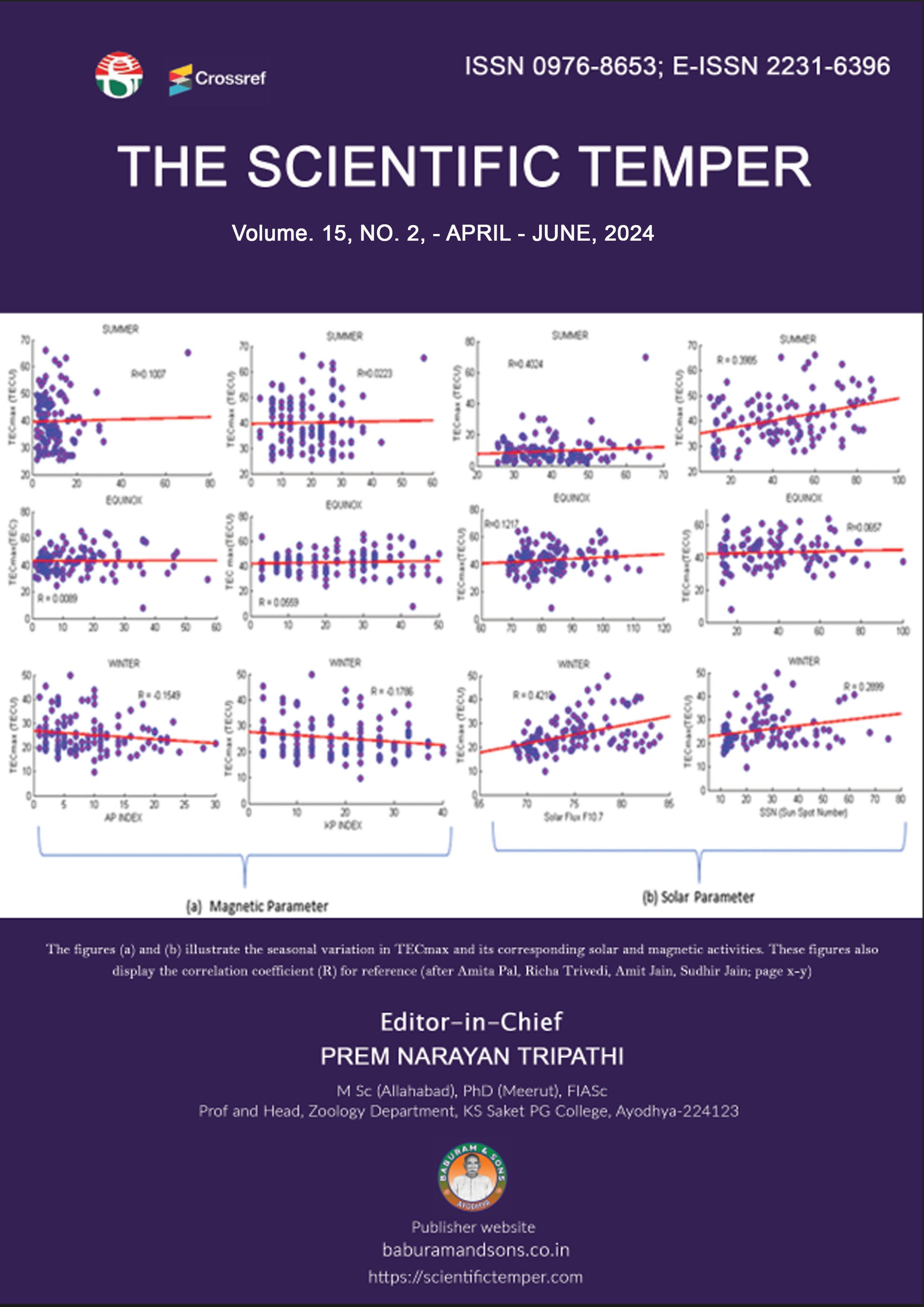
Diurnal and seasonal variation of GPS-TEC during a low solar activity period at EIA region (Bhopal)
Downloads
Published
DOI:
https://doi.org/10.58414/SCIENTIFICTEMPER.2024.15.2.16Keywords:
Keywords: Total Electron Content (TEC); Equatorial Ionization Anomaly (EIA); Global Positioning System (GPS); Solar Indices; Electron Electrojet (EEJ).Dimensions Badge
Issue
Section
License
Copyright (c) 2024 The Scientific Temper

This work is licensed under a Creative Commons Attribution-NonCommercial-ShareAlike 4.0 International License.
The ionosphere near the equatorial ionization anomaly crest region in the Indian ionospheric sector was studied from May 2016 to April 2017, a solar minimum period. Total electron content (TEC) recorded using the multiple frequency GPS receivers at Bhopal (23.2° N, 77.4° E & MLAT 14.2° N) is used for the study. The diurnal variation shows that the day minimum in TEC is attained around 06:00 hours LT, and the day maximum occurs at about 16:00 hours LT. A similar diurnal pattern was observed in all months across various seasons. During the period of study, it was observed that Seasonal variation of TEC was minimal in winter, whereas highest during equinox and summer months. The variation of TECmax with EEJ shows a positive correlation between the parameters for all the months. The highest correlation (0.8398) was observed in January 2017, while it was lowest (0.4004) in March 2017 and the results were compared with earlier observations, and a possible mechanism was discussed.Abstract
How to Cite
Downloads
Similar Articles
- Arunima Dey, Kankana Ghosh, Debangana Chakrabarti, Mahul Brahma, Re-envisioning the mainstream: A study on the acceptance of LGBTQIA+ Protagonists on a Bengali OTT platform , The Scientific Temper: Vol. 16 No. 04 (2025): The Scientific Temper
- Shamba Gowda, AR Chethan Kumar, S. Srinivasaragavan, Scholarly communication behavior in forestry research: A bibliometric analysis of global publications , The Scientific Temper: Vol. 15 No. spl-1 (2024): The Scientific Temper
- Brigith Gladys L, J. Merline Vinotha, Sustainable rough multi-objective two-stage solid transportation problem of third-party e-commerce logistic providers with conditional fixed parameter on safety , The Scientific Temper: Vol. 16 No. 01 (2025): The Scientific Temper
- Jivesh Jha, Sonia D Sharma, Role of law to combat ecological imbalance in Nepal , The Scientific Temper: Vol. 14 No. 01 (2023): The Scientific Temper
- Kunal Lanjekar, Prashant Kalshetti, Joe C. Lopez, Role of social media in lead generation , The Scientific Temper: Vol. 14 No. 04 (2023): The Scientific Temper
- N. Anbarasi, K. Anitha, S. Hemalatha, A study on energy sum of dominating sets in East Indian states , The Scientific Temper: Vol. 16 No. 04 (2025): The Scientific Temper
- Abhishek Dwivedi, Shekhar Verma, SCNN Based Classification Technique for the Face Spoof Detection Using Deep Learning Concept , The Scientific Temper: Vol. 13 No. 02 (2022): The Scientific Temper
- Amanda Q. Okronipa, Jones Y. Nyame, Adoption of health information systems in emerging economies: Evidence from Ghana , The Scientific Temper: Vol. 15 No. 03 (2024): The Scientific Temper
- Abhinav Prakash Yadav, Shubham Gudadhe, Sarika Kumari, Ratna Shukla, Manikant Tripathi, Awadhesh Kumar Shukla, Impact of heavy metals assessments on the physiological aspects of spinach plant (Spinacia oleracea L.) , The Scientific Temper: Vol. 16 No. 01 (2025): The Scientific Temper
- Elangovan G. Reddy, Anjana Devi V, Subedha V, Tirapathi Reddy B, Viswanathan R, A smart irrigation monitoring service using wireless sensor networks , The Scientific Temper: Vol. 14 No. 04 (2023): The Scientific Temper
<< < 3 4 5 6 7 8 9 10 11 12 > >>
You may also start an advanced similarity search for this article.