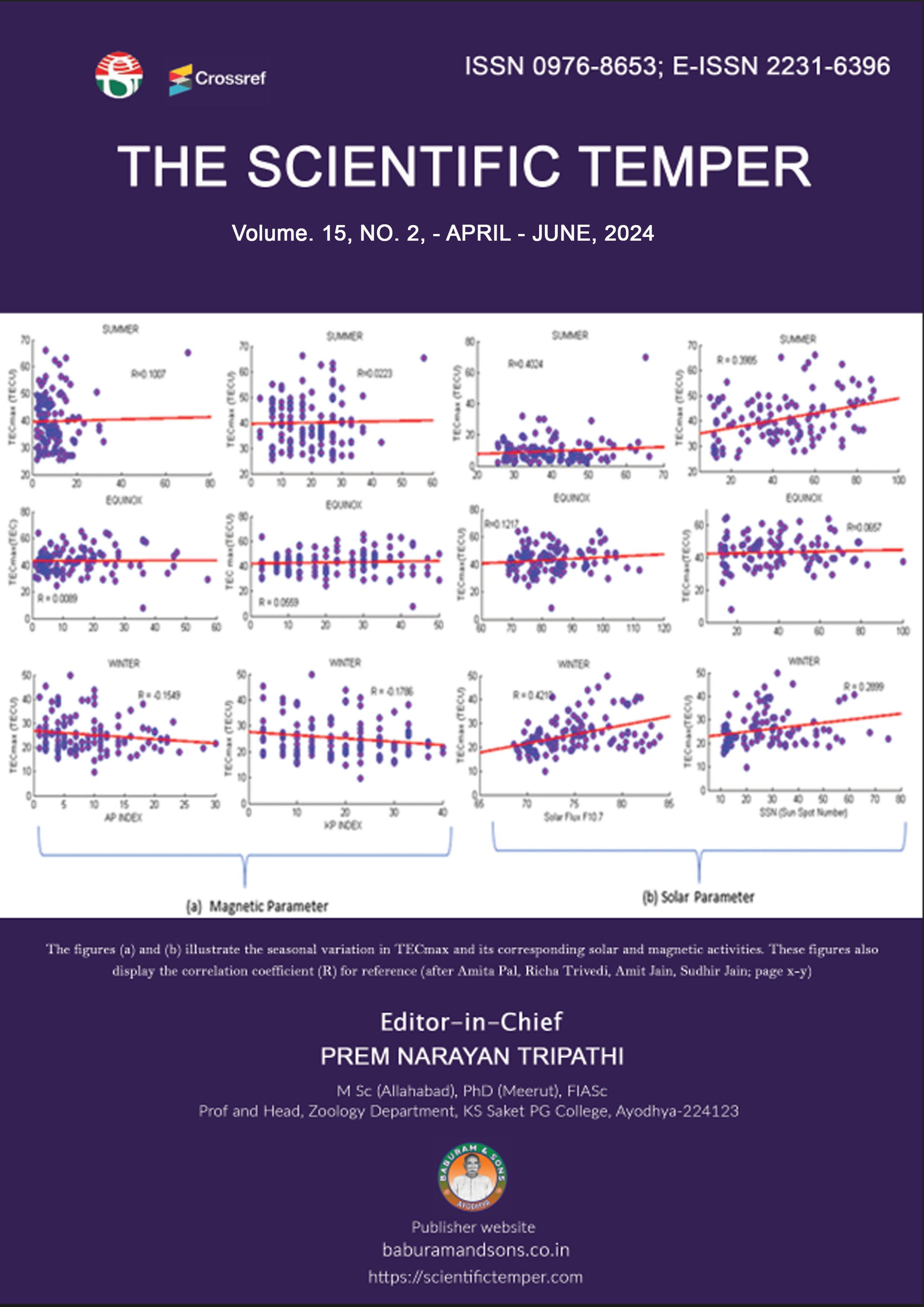
Diurnal and seasonal variation of GPS-TEC during a low solar activity period at EIA region (Bhopal)
Downloads
Published
DOI:
https://doi.org/10.58414/SCIENTIFICTEMPER.2024.15.2.16Keywords:
Keywords: Total Electron Content (TEC); Equatorial Ionization Anomaly (EIA); Global Positioning System (GPS); Solar Indices; Electron Electrojet (EEJ).Dimensions Badge
Issue
Section
License
Copyright (c) 2024 The Scientific Temper

This work is licensed under a Creative Commons Attribution-NonCommercial-ShareAlike 4.0 International License.
The ionosphere near the equatorial ionization anomaly crest region in the Indian ionospheric sector was studied from May 2016 to April 2017, a solar minimum period. Total electron content (TEC) recorded using the multiple frequency GPS receivers at Bhopal (23.2° N, 77.4° E & MLAT 14.2° N) is used for the study. The diurnal variation shows that the day minimum in TEC is attained around 06:00 hours LT, and the day maximum occurs at about 16:00 hours LT. A similar diurnal pattern was observed in all months across various seasons. During the period of study, it was observed that Seasonal variation of TEC was minimal in winter, whereas highest during equinox and summer months. The variation of TECmax with EEJ shows a positive correlation between the parameters for all the months. The highest correlation (0.8398) was observed in January 2017, while it was lowest (0.4004) in March 2017 and the results were compared with earlier observations, and a possible mechanism was discussed.Abstract
How to Cite
Downloads
Similar Articles
- Teklu Hailu, Regasa Begna , Pre-extension demonstration of inter-cropping of improved forages with food and cash crops at Semen Bench Woreda, Southwest Ethiopia , The Scientific Temper: Vol. 15 No. 02 (2024): The Scientific Temper
- Neetu Singh, Ravindra Kumar Singh, Diazinon Effect on Behavior and Morphology of Catfish Clarias batrachus (Linnaeus, 1758) , The Scientific Temper: Vol. 13 No. 01 (2022): The Scientific Temper
- P S Renjeni, B Senthilkumaran, Ramalingam Sugumar, L. Jaya Singh Dhas, Gaussian kernelized transformer learning model for brain tumor risk factor identification and disease diagnosis , The Scientific Temper: Vol. 16 No. 02 (2025): The Scientific Temper
- Anju Bhatnagar, Assessment of antioxidant activity and phytochemical screening in leaf extract of Andrographis paniculate (Burm. f.) nees , The Scientific Temper: Vol. 14 No. 02 (2023): The Scientific Temper
- Pankaj Kumar, Ambrish Pandey, Rajendrakumar Anayath, Study of print suitability of environment-friendly plastics using flexography printing , The Scientific Temper: Vol. 15 No. 01 (2024): The Scientific Temper
- Mallamma V. Reddy, Sachhidanand Sidramappa, Digitization and Recognition of Kannada Inscription Dynasty , The Scientific Temper: Vol. 16 No. 10 (2025): The Scientific Temper
- Isaac Asampana, Henry M. Akwetey, Ben Ocra, Jones Y. Nyame, Albert A. Akanferi, Hannah A. Tanye, Factors motivating the adoption of virtual learning environments in higher education. Is gender relevant? , The Scientific Temper: Vol. 15 No. 01 (2024): The Scientific Temper
- Moyliev Gayrat, Yunuskhodjaev Akhmadkhodja, Saidov Saidamir, Babakhanov Otabek, Mirsultanov Jakhongir, To study references and analysis of an experimental model for skin burns in rats , The Scientific Temper: Vol. 15 No. 01 (2024): The Scientific Temper
- Rupesh Mandal, Bobby Sharma, Dibyajyoti Chutia , Smart flood monitoring in Guwahati city: A LoRa-based AIoT and edge computing sensor framework , The Scientific Temper: Vol. 15 No. 04 (2024): The Scientific Temper
- Sachi Kumari, Amrendra Kumar Jha, STUDY ON DIVERSITY OF RICE FIELD BLUE-GREEN ALGAE FROM RICE FIELD OF CHAPRA IN BIHAR , The Scientific Temper: Vol. 9 No. 1&2 (2018): The Scientific Temper
<< < 6 7 8 9 10 11 12 13 14 15 > >>
You may also start an advanced similarity search for this article.