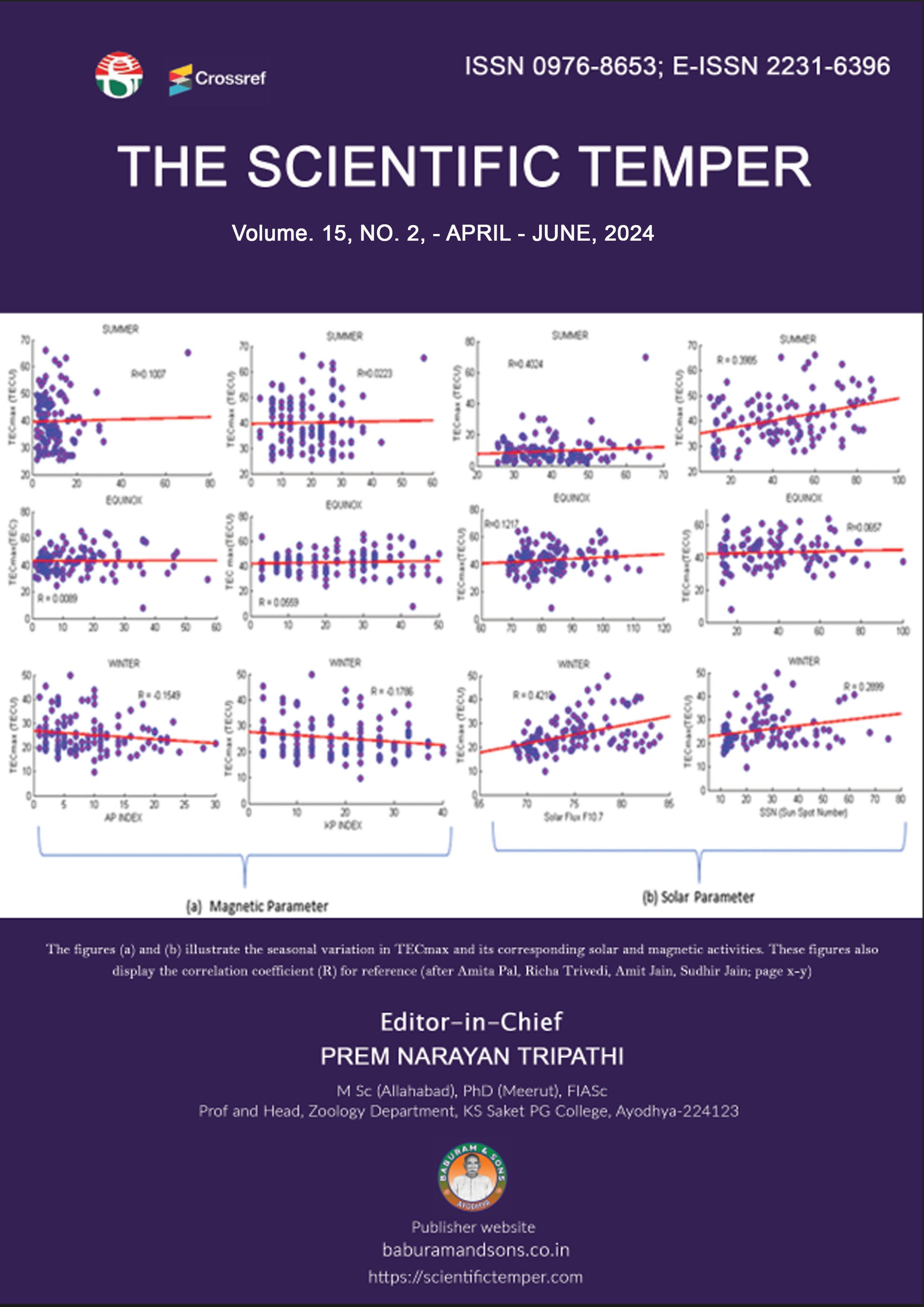
Diurnal and seasonal variation of GPS-TEC during a low solar activity period at EIA region (Bhopal)
Downloads
Published
DOI:
https://doi.org/10.58414/SCIENTIFICTEMPER.2024.15.2.16Keywords:
Keywords: Total Electron Content (TEC); Equatorial Ionization Anomaly (EIA); Global Positioning System (GPS); Solar Indices; Electron Electrojet (EEJ).Dimensions Badge
Issue
Section
License
Copyright (c) 2024 The Scientific Temper

This work is licensed under a Creative Commons Attribution-NonCommercial-ShareAlike 4.0 International License.
The ionosphere near the equatorial ionization anomaly crest region in the Indian ionospheric sector was studied from May 2016 to April 2017, a solar minimum period. Total electron content (TEC) recorded using the multiple frequency GPS receivers at Bhopal (23.2° N, 77.4° E & MLAT 14.2° N) is used for the study. The diurnal variation shows that the day minimum in TEC is attained around 06:00 hours LT, and the day maximum occurs at about 16:00 hours LT. A similar diurnal pattern was observed in all months across various seasons. During the period of study, it was observed that Seasonal variation of TEC was minimal in winter, whereas highest during equinox and summer months. The variation of TECmax with EEJ shows a positive correlation between the parameters for all the months. The highest correlation (0.8398) was observed in January 2017, while it was lowest (0.4004) in March 2017 and the results were compared with earlier observations, and a possible mechanism was discussed.Abstract
How to Cite
Downloads
Similar Articles
- Seema Yadav, Problems and Perspectives in Sustainable Environment in the World: A Legal Study , The Scientific Temper: Vol. 12 No. 1&2 (2021): The Scientific Temper
- Parul Yadav, Priyanka Suryavanshi, Storage study on compositional analysis of quinoa and ragi based snacks , The Scientific Temper: Vol. 15 No. 02 (2024): The Scientific Temper
- Mohiyuddeen Hafzal, Gayathri B.J., M. Meghana Shet, Shaping the future: Education and skill development for Viksit Bharat@2047 , The Scientific Temper: Vol. 15 No. spl-2 (2024): The Scientific Temper
- R. Selvakumar, A. Manimaran, Janani G, K.R. Shanthy, Design and development of artificial intelligence assisted railway gate controlling system using internet of things , The Scientific Temper: Vol. 14 No. 04 (2023): The Scientific Temper
- Pooja Soni, Vikramaditya Dave, Sujit Kumar, Hemani Paliwal, A comparative study of AI-driven techno-economic analysis for grid-tied solar PV-fuel cell hybrid power systems , The Scientific Temper: Vol. 15 No. 02 (2024): The Scientific Temper
- Damtew Girma, Addisalem Mebratu, Fresew Belete, Response of potato (Solanum tuberosum L.) varieties to blended NPSB fertilizer rates on tuber yield and quality parameters in Gummer district, Southern Ethiopia , The Scientific Temper: Vol. 14 No. 03 (2023): The Scientific Temper
- P. N. Malleswari, P. V. S. Gupta, S. V. M. Vardhan, D. Ramachandran, Quantitative estimation of ethanol content in eribulin mesylate injection using headspace gas chromatographic with flame ionization detector [HS-GC-FID] , The Scientific Temper: Vol. 15 No. 02 (2024): The Scientific Temper
- I.Bhuvaneshwarri, M. N. Sudha, An implementation of secure storage using blockchain technology on cloud environment , The Scientific Temper: Vol. 14 No. 03 (2023): The Scientific Temper
- D. Jayaprasanth, J. Arul Melissa, Extended Kalman filter-based prognostic of actuator degradation in two tank system , The Scientific Temper: Vol. 14 No. 02 (2023): The Scientific Temper
- Arunima Dey, New gender representation on the Indian OTT platform: A study on web series “Made in Heaven” , The Scientific Temper: Vol. 15 No. 01 (2024): The Scientific Temper
<< < 1 2 3 4 5 6 7 8 9 10 > >>
You may also start an advanced similarity search for this article.