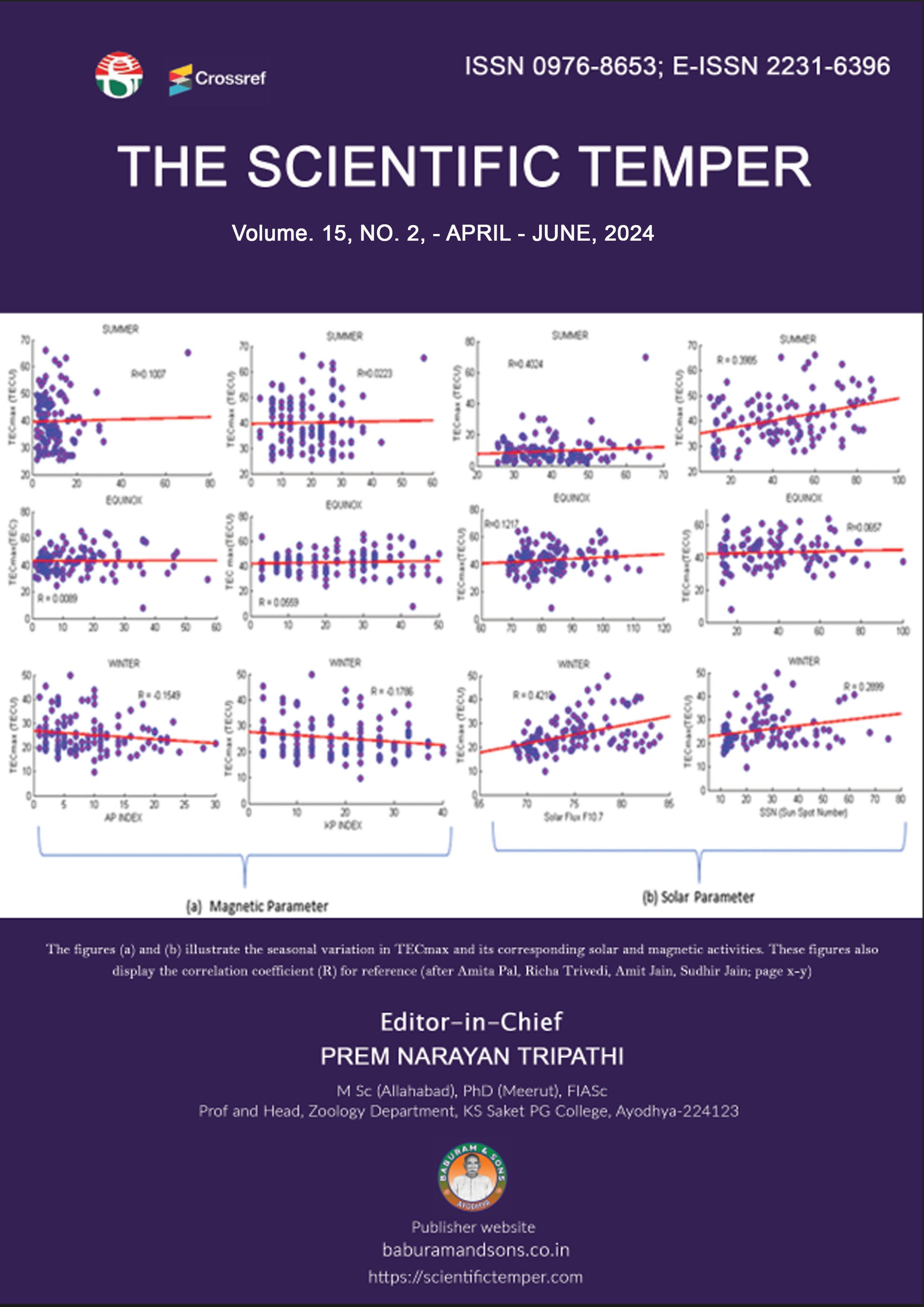
Diurnal and seasonal variation of GPS-TEC during a low solar activity period at EIA region (Bhopal)
Downloads
Published
DOI:
https://doi.org/10.58414/SCIENTIFICTEMPER.2024.15.2.16Keywords:
Keywords: Total Electron Content (TEC); Equatorial Ionization Anomaly (EIA); Global Positioning System (GPS); Solar Indices; Electron Electrojet (EEJ).Dimensions Badge
Issue
Section
License
Copyright (c) 2024 The Scientific Temper

This work is licensed under a Creative Commons Attribution-NonCommercial-ShareAlike 4.0 International License.
The ionosphere near the equatorial ionization anomaly crest region in the Indian ionospheric sector was studied from May 2016 to April 2017, a solar minimum period. Total electron content (TEC) recorded using the multiple frequency GPS receivers at Bhopal (23.2° N, 77.4° E & MLAT 14.2° N) is used for the study. The diurnal variation shows that the day minimum in TEC is attained around 06:00 hours LT, and the day maximum occurs at about 16:00 hours LT. A similar diurnal pattern was observed in all months across various seasons. During the period of study, it was observed that Seasonal variation of TEC was minimal in winter, whereas highest during equinox and summer months. The variation of TECmax with EEJ shows a positive correlation between the parameters for all the months. The highest correlation (0.8398) was observed in January 2017, while it was lowest (0.4004) in March 2017 and the results were compared with earlier observations, and a possible mechanism was discussed.Abstract
How to Cite
Downloads
Similar Articles
- S Prabhakaran, Yugeshkrishnan M, Santhiya M, Danush Kumar S M, Smart Dustbin using IOT , The Scientific Temper: Vol. 14 No. 02 (2023): The Scientific Temper
- V. Parimala, D. Ganeshkumar, Solar energy-driven water distillation with nanoparticle integration for enhanced efficiency, sustainability, and potable water production in arid regions , The Scientific Temper: Vol. 15 No. 01 (2024): The Scientific Temper
- P. Rathinabhagya, J. Merline Vinotha, Fuzzy vehicle routing problem for a municipal solid waste management system with greenhouse gas emission at various disposal stages , The Scientific Temper: Vol. 16 No. 04 (2025): The Scientific Temper
- Amresh Kumar Singh, Manjit Singh Chhetri, Pushyamitra Mishra, Toughness and Ductile Brittle Transition Temperature of Different Mineral Filler Reinforced TPOs Composites , The Scientific Temper: Vol. 13 No. 02 (2022): The Scientific Temper
- Getasew Mesfin, Isreal Zewide, Abdeta Jembere, Physicochemical Characterization of Vermicompost and its Effect on Acidic Soils in Ethiopia , The Scientific Temper: Vol. 14 No. 01 (2023): The Scientific Temper
- Somnath Bose, Preeti Singh, Changes in Total Serum Calcium Level and Shell Calcium Content in Bank Myna, Acridotheres ginginianus (Latham) During Breeding Season , The Scientific Temper: Vol. 7 No. 1&2 (2016): THE SCIENTIFIC TEMPER
- Remya Raj B., R. Suganya, A novel and an effective intrusion detection system using machine learning techniques , The Scientific Temper: Vol. 15 No. 03 (2024): The Scientific Temper
- Manikannan Palanivel, Alaudeen A, Pandiyan K. S, Sivaprakasam P, Hybrid fuzzy and fire fly algorithm-based MPPT controller for PV system using super lift boost converter , The Scientific Temper: Vol. 14 No. 03 (2023): The Scientific Temper
- Nalini. S, Ritha. W, Sasitharan Nagapan, Optimal Inventory Policies for Perishable Products Under Demand and Lead Time Uncertainty , The Scientific Temper: Vol. 16 No. 09 (2025): The Scientific Temper
- N.S.G. Ganesh, V Arulkumar, R. Lathamanju, Priscilla Joy , Energetic and highly reliable photovoltaic power source assisted water pump control system design using IoT , The Scientific Temper: Vol. 14 No. 04 (2023): The Scientific Temper
<< < 1 2 3 4 5 6 7 8 9 10 > >>
You may also start an advanced similarity search for this article.