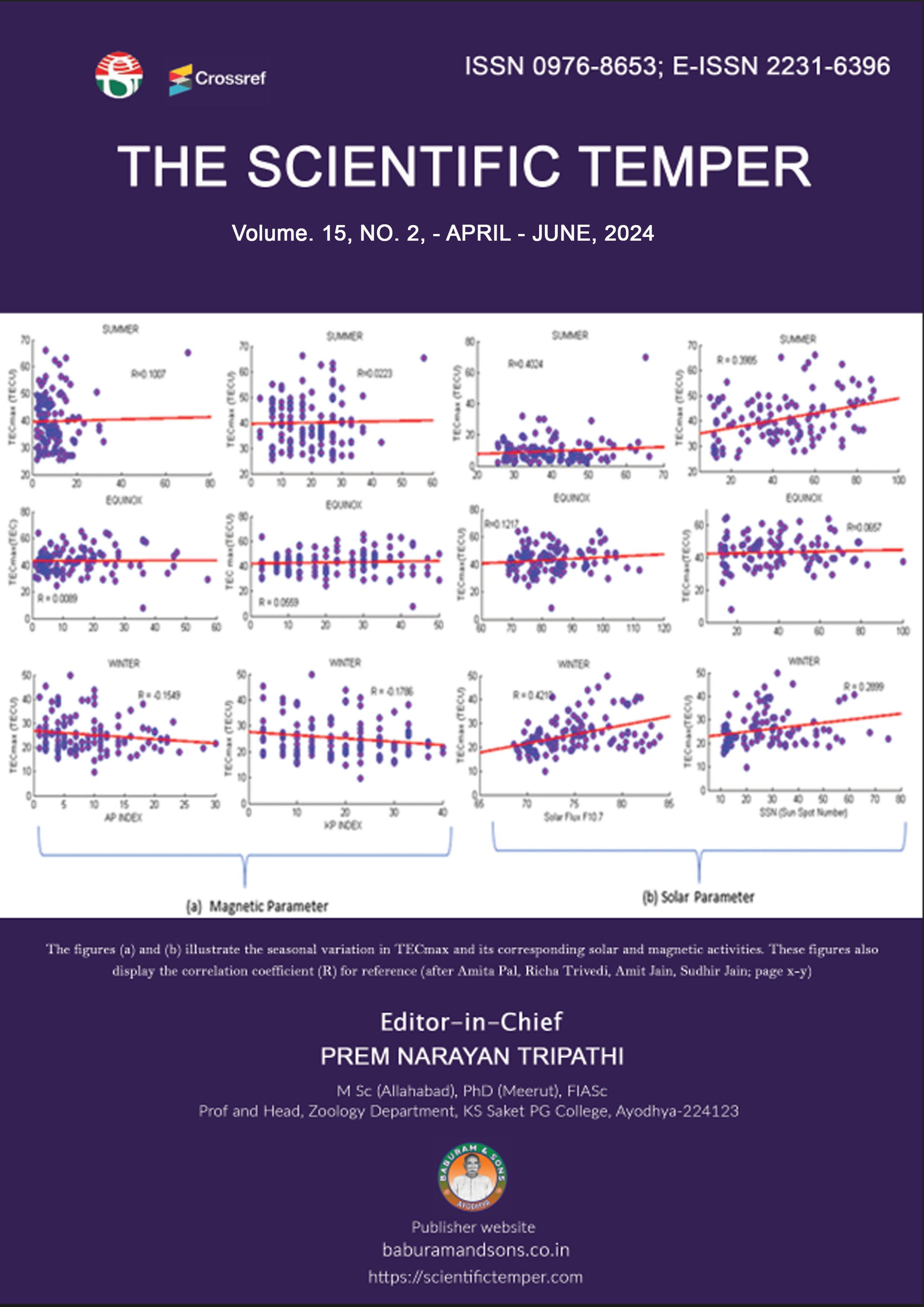
Diurnal and seasonal variation of GPS-TEC during a low solar activity period at EIA region (Bhopal)
Downloads
Published
DOI:
https://doi.org/10.58414/SCIENTIFICTEMPER.2024.15.2.16Keywords:
Keywords: Total Electron Content (TEC); Equatorial Ionization Anomaly (EIA); Global Positioning System (GPS); Solar Indices; Electron Electrojet (EEJ).Dimensions Badge
Issue
Section
License
Copyright (c) 2024 The Scientific Temper

This work is licensed under a Creative Commons Attribution-NonCommercial-ShareAlike 4.0 International License.
The ionosphere near the equatorial ionization anomaly crest region in the Indian ionospheric sector was studied from May 2016 to April 2017, a solar minimum period. Total electron content (TEC) recorded using the multiple frequency GPS receivers at Bhopal (23.2° N, 77.4° E & MLAT 14.2° N) is used for the study. The diurnal variation shows that the day minimum in TEC is attained around 06:00 hours LT, and the day maximum occurs at about 16:00 hours LT. A similar diurnal pattern was observed in all months across various seasons. During the period of study, it was observed that Seasonal variation of TEC was minimal in winter, whereas highest during equinox and summer months. The variation of TECmax with EEJ shows a positive correlation between the parameters for all the months. The highest correlation (0.8398) was observed in January 2017, while it was lowest (0.4004) in March 2017 and the results were compared with earlier observations, and a possible mechanism was discussed.Abstract
How to Cite
Downloads
Similar Articles
- M. Iniyan, A. Banumathi, Brower blowfish nash secured stochastic neural network based disease diagnosis for medical WBAN in cloud environment , The Scientific Temper: Vol. 15 No. 03 (2024): The Scientific Temper
- U. Johns Praveena, J. Merline Vinotha, Bilevel Fractional/Quadratic Green Transshipment Problem by Implementing AI traffic control system with Multi Choice Parameters Under Fuzzy Environment , The Scientific Temper: Vol. 16 No. 11 (2025): The Scientific Temper
- G. Tripathi, R. Deora, FAUNA – ASSISTED LITTER DECOMPOSITION AND ITS IMPACT ON CHEMICAL AND BIOLOGICAL HEALTH OF BALANITES AEGYPTIACA BASED SILVIPASTURE SYSTEM , The Scientific Temper: Vol. 1 No. 01 (2010): The Scientific Temper
- L. Vamsi Narasimha Rao, P.S.Prakash, M.Veera Kumari, Improvement of power system operation using a novel hybrid optimization method for optimal allocation of facts devices in radial transmission line , The Scientific Temper: Vol. 15 No. 04 (2024): The Scientific Temper
- Rekha Raghavendra, Shobha Gowda, Jissy Thomas, Fingerprint doorlock system using Arduino uno , The Scientific Temper: Vol. 16 No. Spl-2 (2025): The Scientific Temper
- S. Kumar, M. Santhanalakshmi , R. Navaneethakrishnan, Content addressable memory for energy efficient computing applications , The Scientific Temper: Vol. 14 No. 02 (2023): The Scientific Temper
- Aman Bora, Akhilesh Dwivedi, From Protectionism to Green Multilateralism: Trade Diplomacy and Environmental Accountability in the Global South , The Scientific Temper: Vol. 16 No. 10 (2025): The Scientific Temper
- M. Monika, J. Merline Vinotha, A Fuzzy Supply Chain Model Evaluating Energy Management Systems under Imperfect Production and Uncertain Costs , The Scientific Temper: Vol. 16 No. 11 (2025): The Scientific Temper
- Shripada Patil, Sandeep N. Jagdale, Prashant Kalshetti, Management education system in the 21st century: Challenges and opportunities , The Scientific Temper: Vol. 14 No. 04 (2023): The Scientific Temper
- Neha Chitale, Lajwanti Lalwani, A Bibliometric Analysis of Global Research From 1928 To 2019 On Mobilization with Movement on Functional Disability in Low Back Pain , The Scientific Temper: Vol. 16 No. 10 (2025): The Scientific Temper
<< < 1 2 3 4 5 6 7 8 9 10 > >>
You may also start an advanced similarity search for this article.