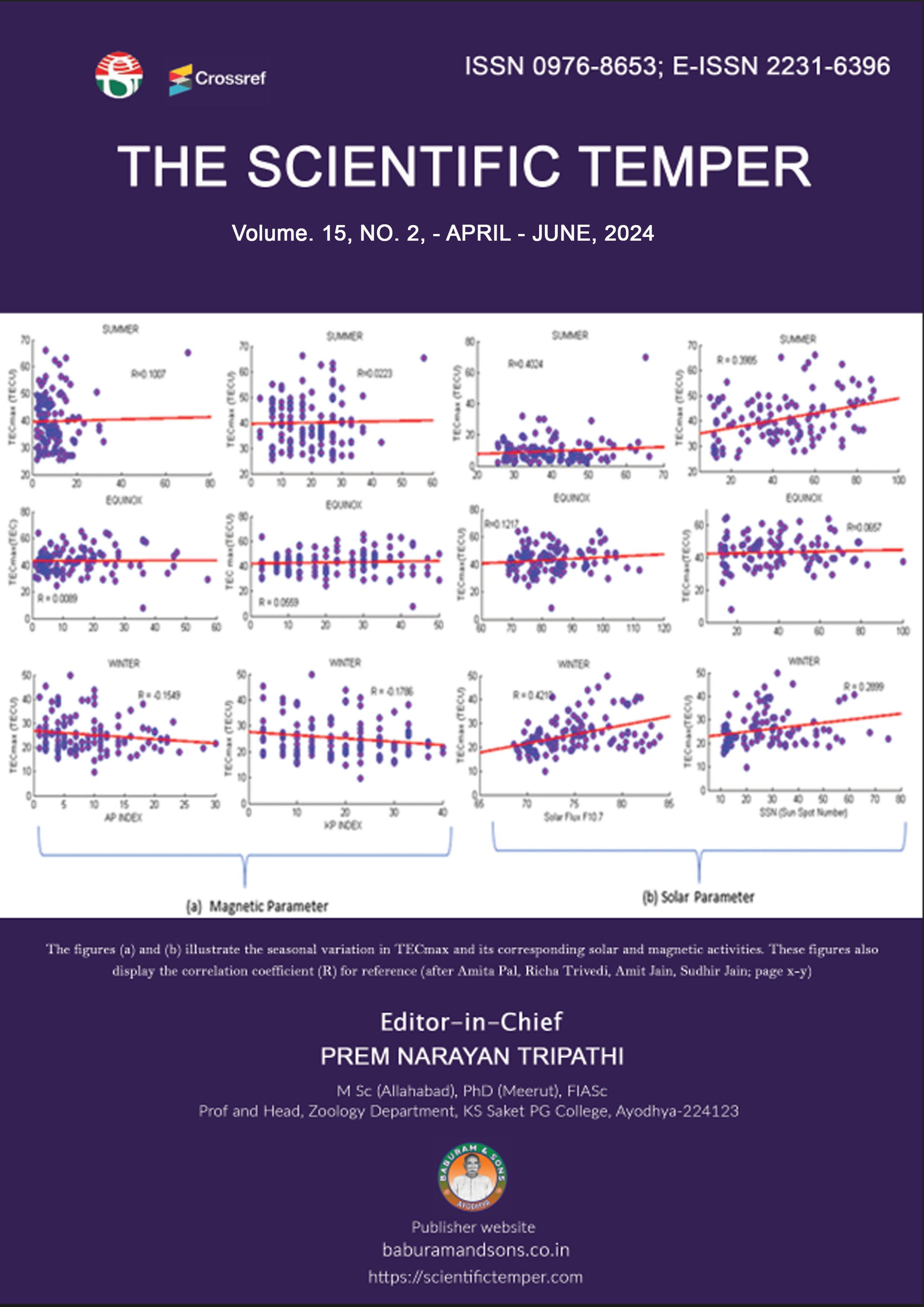
Diurnal and seasonal variation of GPS-TEC during a low solar activity period at EIA region (Bhopal)
Downloads
Published
DOI:
https://doi.org/10.58414/SCIENTIFICTEMPER.2024.15.2.16Keywords:
Keywords: Total Electron Content (TEC); Equatorial Ionization Anomaly (EIA); Global Positioning System (GPS); Solar Indices; Electron Electrojet (EEJ).Dimensions Badge
Issue
Section
License
Copyright (c) 2024 The Scientific Temper

This work is licensed under a Creative Commons Attribution-NonCommercial-ShareAlike 4.0 International License.
The ionosphere near the equatorial ionization anomaly crest region in the Indian ionospheric sector was studied from May 2016 to April 2017, a solar minimum period. Total electron content (TEC) recorded using the multiple frequency GPS receivers at Bhopal (23.2° N, 77.4° E & MLAT 14.2° N) is used for the study. The diurnal variation shows that the day minimum in TEC is attained around 06:00 hours LT, and the day maximum occurs at about 16:00 hours LT. A similar diurnal pattern was observed in all months across various seasons. During the period of study, it was observed that Seasonal variation of TEC was minimal in winter, whereas highest during equinox and summer months. The variation of TECmax with EEJ shows a positive correlation between the parameters for all the months. The highest correlation (0.8398) was observed in January 2017, while it was lowest (0.4004) in March 2017 and the results were compared with earlier observations, and a possible mechanism was discussed.Abstract
How to Cite
Downloads
Similar Articles
- S. Mohamed Iliyas, M. Mohamed Surputheen, A.R. Mohamed Shanavas, Enhanced Block Chain Financial Transaction Security Using Chain Link Smart Agreement based Secure Elliptic Curve Cryptography , The Scientific Temper: Vol. 16 No. 10 (2025): The Scientific Temper
- Priydarshi Shireesh, Tiwari Atul Kumar, Singh Prashant, Rai Kumud, Mishra Dev Brat, Comparative Water Quality Analysis in Beso River in District Jaunpur, Azamgarh and Ghazipur Uttar Pradesh , The Scientific Temper: Vol. 12 No. 1&2 (2021): The Scientific Temper
- Bajeesh Balakrishnan, Swetha A. Parivara, E-HRM: Learning approaches, applications and the role of artificial intelligence , The Scientific Temper: Vol. 14 No. 04 (2023): The Scientific Temper
- Isreal Zewide, A coffee biochar-mineral NP interaction: Boon for soil health , The Scientific Temper: Vol. 15 No. 02 (2024): The Scientific Temper
- Krutuja S. Gadgil, Prabodh Khampariya, Shashikant M. Bakre, Investigation of power quality problems and harmonic exclusion in the power system using frequency estimation techniques , The Scientific Temper: Vol. 14 No. 01 (2023): The Scientific Temper
- Mahmudov E. Heydar, Aliyev S. Shakir, Abbasova S. Camal, Nadirkhanova D Adalat, Museyibli E Bakir, Huseynova G Shixi, The role of agricultural marketing in the formation of export potential in the post-conflict region of the Republic of Azerbaijan , The Scientific Temper: Vol. 14 No. 04 (2023): The Scientific Temper
- Muruganantham P, Harshavardhan J, Rajesh PK , Neelakrishnan S, Implementation of flexible and customizable free-from mirror heads-up display , The Scientific Temper: Vol. 14 No. 02 (2023): The Scientific Temper
- Mohamed Azharudheen A, Vijayalakshmi V, Improvement of data analysis and protection using novel privacy-preserving methods for big data application , The Scientific Temper: Vol. 15 No. 02 (2024): The Scientific Temper
- NAVEEN KUMAR SHARMA, KAPIL KUMAR, A REVIEW OF HIMALAYAN BIODIVERSITY WITH REFERENCE TO UTTARAKHAND , The Scientific Temper: Vol. 10 No. 1&2 (2019): The Scientific Temper
- Desai Vishesh, Ritesh Patel, Assessing the influence of tax refunds and incentives on personal tax Reporting: A qualitative perspective , The Scientific Temper: Vol. 16 No. 03 (2025): The Scientific Temper
<< < 9 10 11 12 13 14 15 16 17 18 > >>
You may also start an advanced similarity search for this article.