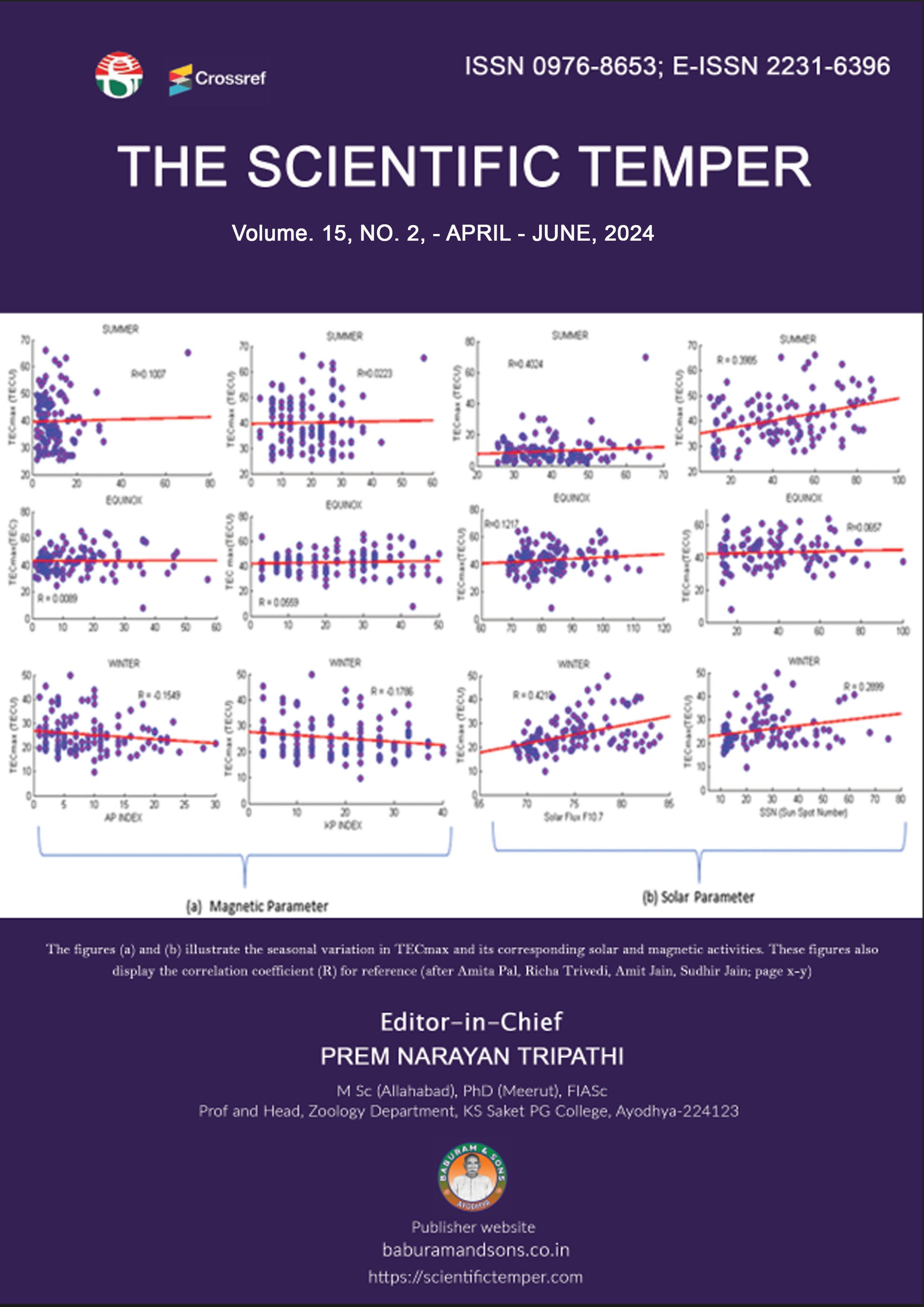
Diurnal and seasonal variation of GPS-TEC during a low solar activity period at EIA region (Bhopal)
Downloads
Published
DOI:
https://doi.org/10.58414/SCIENTIFICTEMPER.2024.15.2.16Keywords:
Keywords: Total Electron Content (TEC); Equatorial Ionization Anomaly (EIA); Global Positioning System (GPS); Solar Indices; Electron Electrojet (EEJ).Dimensions Badge
Issue
Section
License
Copyright (c) 2024 The Scientific Temper

This work is licensed under a Creative Commons Attribution-NonCommercial-ShareAlike 4.0 International License.
The ionosphere near the equatorial ionization anomaly crest region in the Indian ionospheric sector was studied from May 2016 to April 2017, a solar minimum period. Total electron content (TEC) recorded using the multiple frequency GPS receivers at Bhopal (23.2° N, 77.4° E & MLAT 14.2° N) is used for the study. The diurnal variation shows that the day minimum in TEC is attained around 06:00 hours LT, and the day maximum occurs at about 16:00 hours LT. A similar diurnal pattern was observed in all months across various seasons. During the period of study, it was observed that Seasonal variation of TEC was minimal in winter, whereas highest during equinox and summer months. The variation of TECmax with EEJ shows a positive correlation between the parameters for all the months. The highest correlation (0.8398) was observed in January 2017, while it was lowest (0.4004) in March 2017 and the results were compared with earlier observations, and a possible mechanism was discussed.Abstract
How to Cite
Downloads
Similar Articles
- Sachi Kumari, Amrendra Kumar Jha, STUDY ON DIVERSITY OF RICE FIELD BLUE-GREEN ALGAE FROM RICE FIELD OF CHAPRA IN BIHAR , The Scientific Temper: Vol. 9 No. 1&2 (2018): The Scientific Temper
- Raghvendra, Tulika Saxena, Saurabh Verma, Rashi Saxena, Smita Dron, Shilpi Singh, Combination of financial literacy, strategic marketing and effective human resource for sustainable household wealth development , The Scientific Temper: Vol. 15 No. 03 (2024): The Scientific Temper
- Sharada C, T N Ravi, S Panneer Arokiara, Lancaster sliced regressive keyword extraction based semantic analytics on social media documents , The Scientific Temper: Vol. 16 No. 08 (2025): The Scientific Temper
- Jasmine A, G. Arul Selvi, Exploring Behavioural Dimensions of Social Media Engagement: An Exploratory Factor Analysis Among College Youth , The Scientific Temper: Vol. 17 No. 02 (2026): The Scientific Temper
- Jambhu Kumar V, Anusha M, Data Centre Optimization for Cloud Computing and Virtualization , The Scientific Temper: Vol. 17 No. 05 (2026): The Scientific Temper
- Sathya R., Balamurugan P, Classification of glaucoma in retinal fundus images using integrated YOLO-V8 and deep CNN , The Scientific Temper: Vol. 15 No. 03 (2024): The Scientific Temper
- Preeti Gupta, Shalie Malik, Photoperiodic Supervision and Adaptability in Avian System , The Scientific Temper: Vol. 11 No. 1&2 (2020): The Scientific Temper
- Karthik Gangadhar, Prem Kumar N, Neuroprotective activity of alcoholic extract of Operculina turpethum roots in aluminum chloride-induced Alzheimer’s disease in rats , The Scientific Temper: Vol. 15 No. 04 (2024): The Scientific Temper
- Ruchi Tiwari, Vipinchandra Tiwari, Vinitkumar Jagdishprasad Varma, Human Rights Disclosure in the Indian Banking Sector , The Scientific Temper: Vol. 17 No. 03 (2026): The Scientific Temper
- Elizabeth Mize, A critical analysis of the continuing professional development of teachers in India through the lens of NEP 2020 , The Scientific Temper: Vol. 16 No. 03 (2025): The Scientific Temper
<< < 8 9 10 11 12 13 14 15 16 17 > >>
You may also start an advanced similarity search for this article.