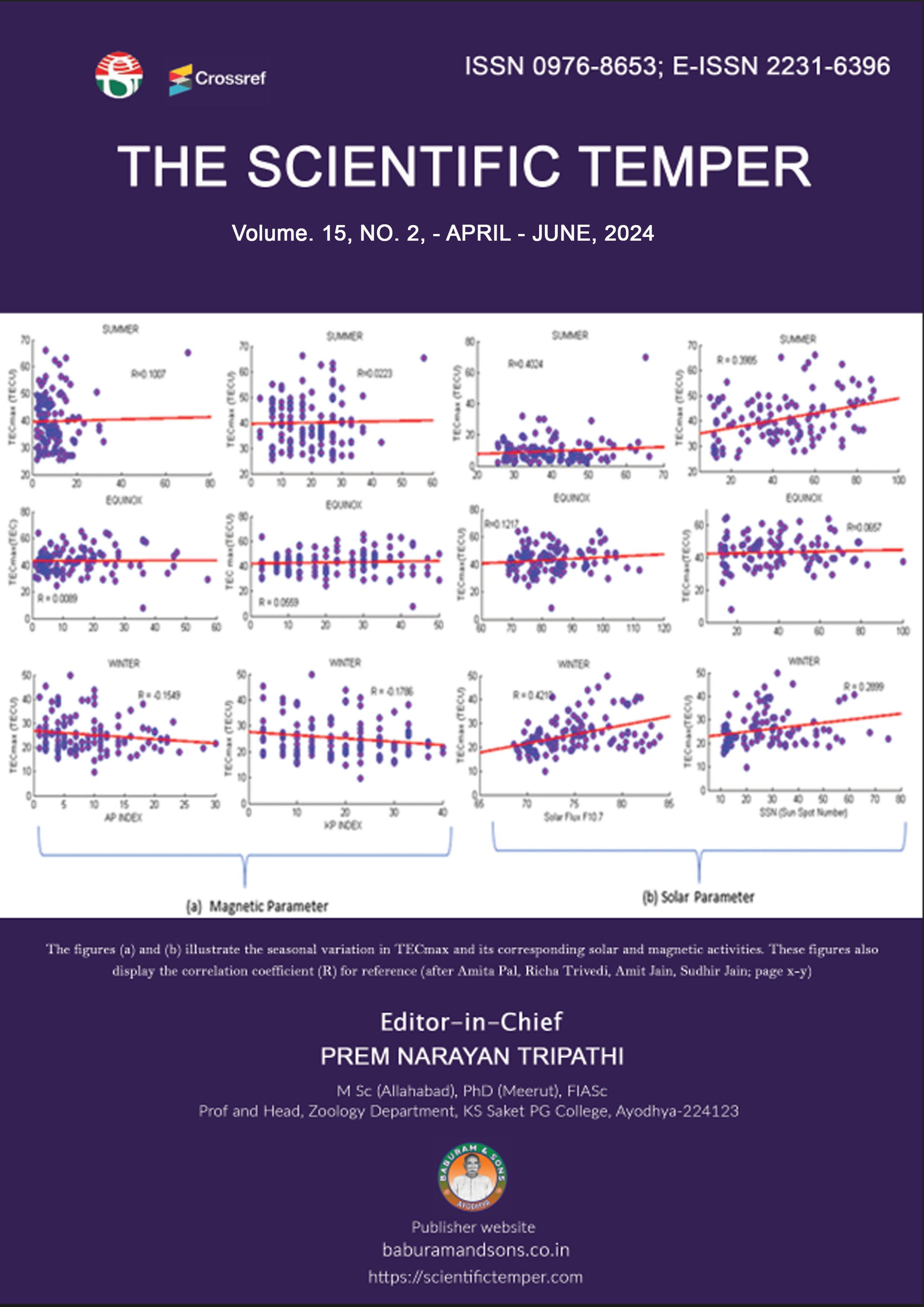
Diurnal and seasonal variation of GPS-TEC during a low solar activity period at EIA region (Bhopal)
Downloads
Published
DOI:
https://doi.org/10.58414/SCIENTIFICTEMPER.2024.15.2.16Keywords:
Keywords: Total Electron Content (TEC); Equatorial Ionization Anomaly (EIA); Global Positioning System (GPS); Solar Indices; Electron Electrojet (EEJ).Dimensions Badge
Issue
Section
License
Copyright (c) 2024 The Scientific Temper

This work is licensed under a Creative Commons Attribution-NonCommercial-ShareAlike 4.0 International License.
The ionosphere near the equatorial ionization anomaly crest region in the Indian ionospheric sector was studied from May 2016 to April 2017, a solar minimum period. Total electron content (TEC) recorded using the multiple frequency GPS receivers at Bhopal (23.2° N, 77.4° E & MLAT 14.2° N) is used for the study. The diurnal variation shows that the day minimum in TEC is attained around 06:00 hours LT, and the day maximum occurs at about 16:00 hours LT. A similar diurnal pattern was observed in all months across various seasons. During the period of study, it was observed that Seasonal variation of TEC was minimal in winter, whereas highest during equinox and summer months. The variation of TECmax with EEJ shows a positive correlation between the parameters for all the months. The highest correlation (0.8398) was observed in January 2017, while it was lowest (0.4004) in March 2017 and the results were compared with earlier observations, and a possible mechanism was discussed.Abstract
How to Cite
Downloads
Similar Articles
- C. Muruganandam, V. Maniraj, A Self-driven dual reinforcement model with meta heuristic framework to conquer the iot based clustering to enhance agriculture production , The Scientific Temper: Vol. 15 No. 02 (2024): The Scientific Temper
- Somnath Bose, Preeti Singh, INFLUENCE OF SUNLIGHT EXPOSURE ON TOTAL SERUM CALCIUM AND INORGANIC PHOSPHATE LEVEL IN BANK MYNA, ACRIDOTHERES GINGINIANUS (LATHAM) , The Scientific Temper: Vol. 8 No. 1&2 (2017): The Scientific Temper
- B Bindu, Srikanth N, Haris Raja V, Barath Kumar JK, Dharmendra R, Comparative analysis of inverted pendulum control , The Scientific Temper: Vol. 14 No. 02 (2023): The Scientific Temper
- R. Prabhu, P. Archana, S. Anusooya, P. Anuradha, Improved Steganography for IoT Network Node Data Security Promoting Secure Data Transmission using Generative Adversarial Networks , The Scientific Temper: Vol. 14 No. 03 (2023): The Scientific Temper
- Priyanka Patel, Bhaskar Pandya, The idea of Indianness in Indian literature: An analysis of social and cultural themes in the short stories of Rabindranath Tagore, Mulk Raj Anand, and R.K. Narayan , The Scientific Temper: Vol. 16 No. Spl-1 (2025): The Scientific Temper
- R. B. Ram, A. K. Gautam, Rubee Lata, STUDIES ON SURVEY, COLLECTION AND EVALUATION OF WATER CHESTNUT (TRAPA NATANS VAR. BISPINOSA ROXB.) UNDER SATHIAON BLOCK OF AZAMGARH DISTRICT OF UTTAR PRADESH , The Scientific Temper: Vol. 1 No. 01 (2010): The Scientific Temper
- Sudheer Choudari, K. Rajasekhar, Ch. Sudheer, Comparative study of the foundation model of a 220 kV transmission line tower with different footing steps - Finite element analysis , The Scientific Temper: Vol. 15 No. 03 (2024): The Scientific Temper
- Finney D. Shadrach, Harsshini S, Darshini R, Grapevine leaf species and disease detection using DNN , The Scientific Temper: Vol. 14 No. 03 (2023): The Scientific Temper
- Olivia C. Gold, Jayasimman Lawrence, Enhanced LSTM for heart disease prediction in IoT-enabled smart healthcare systems , The Scientific Temper: Vol. 15 No. 02 (2024): The Scientific Temper
- Ajay Kumar, Sunder S. Arya, Neha Yadav, Mamta Sawariya, Naveen Kumar, Himanshu Mehra, Sunil Kumar, Assessing the role of EDTA and SA in mustard under Cd and Pb stress , The Scientific Temper: Vol. 15 No. 01 (2024): The Scientific Temper
<< < 11 12 13 14 15 16 17 18 19 20 > >>
You may also start an advanced similarity search for this article.