
Convergence of Bisection Method
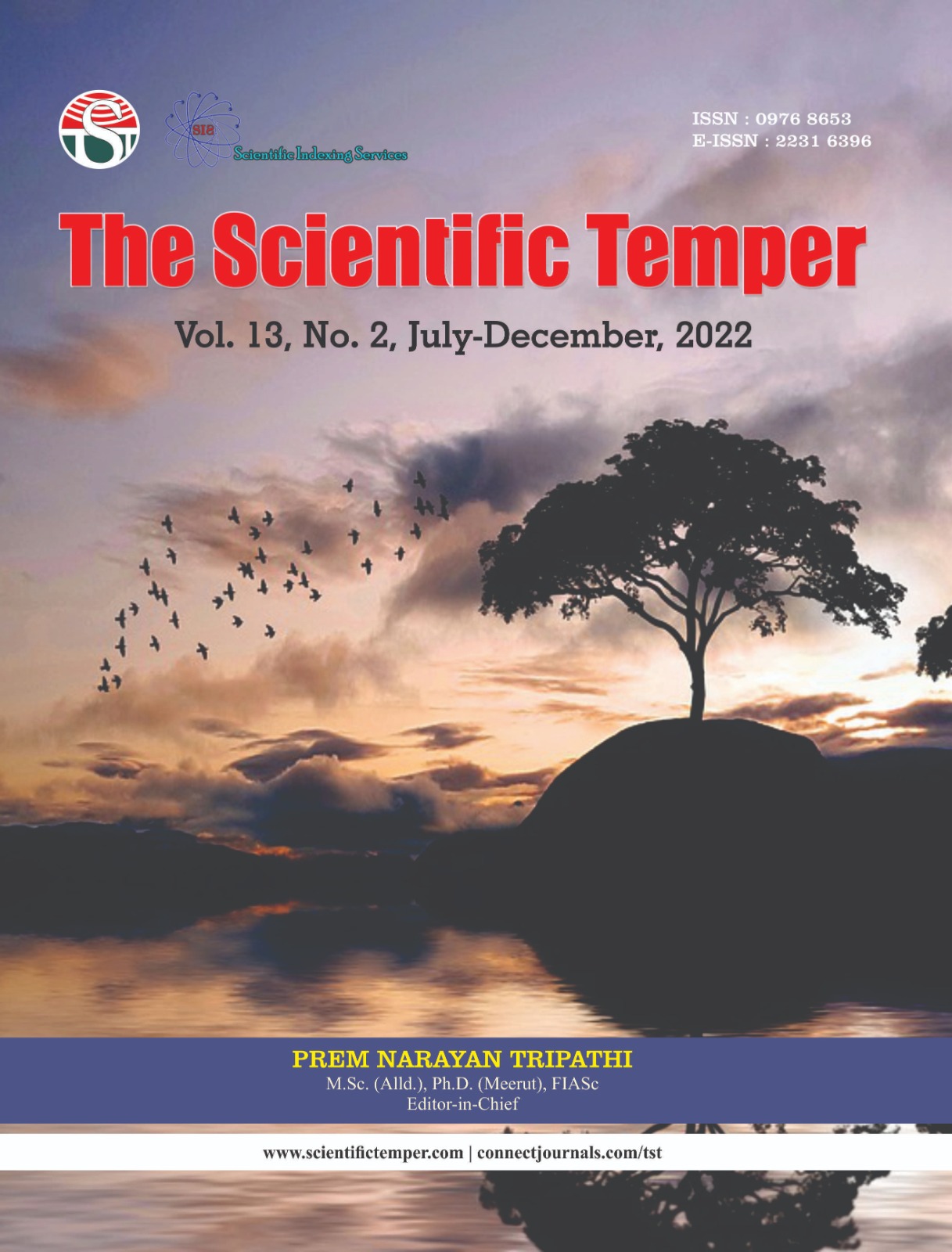
Downloads
Published
DOI:
https://doi.org/10.58414/SCIENTIFICTEMPER.2022.13.2.14Keywords:
Bisection method, convergence, stopping tolerance, error, percentage error, computer program, iterations.Dimensions Badge
Issue
Section
License
Copyright (c) 2022 The Scientific Temper

This work is licensed under a Creative Commons Attribution-NonCommercial-ShareAlike 4.0 International License.
Fourth roots of the natural numbers from 1 to 30 have been calculated by Bisection method in the interval [0, 3] using stopping tolerance 0f 0.00001. Calculated roots have been compared with the actual values of roots to obtain error and percentage error in the calculated roots. Numerical rate of convergence has also been calculated in the determination of each fourthroot. The highest numerical rate of convergence of Bisection method has been observed in the calculation of fourth root of 2 and is equal to 1.754385964912. The lowest numerical rate of convergence of Bisection method has been observed in the calculation of fourth roots of 1, 3, -8, 10, 12 and is equal to 1.333333333333. Average error, average percentage error and average numerical rate of convergence of Bisection method have been found to be 0.000000062635, 0.000003048055 and 1.458082183940 respectivelyAbstract
How to Cite
Downloads
Similar Articles
- M. Rajalakshmi, V. Sulochana, Enhancing deep learning model performance in air quality classification through probabilistic hyperparameter tuning with tree-structured Parzen estimators , The Scientific Temper: Vol. 14 No. 04 (2023): The Scientific Temper
- Kavitha V, Panneer Arokiaraj S., RPL-eSOA: Enhancing IoT network sustainability with RPL and enhanced sandpiper optimization algorithm , The Scientific Temper: Vol. 15 No. 03 (2024): The Scientific Temper
- Amit Maru, Dhaval Vyas, Hybrid deep learning approach for pre-flood and post-flood classification of remote sensed data , The Scientific Temper: Vol. 16 No. Spl-1 (2025): The Scientific Temper
- A. Sahaya Mercy, Dr. G. Arockia Sahaya Sheela, Speckle-Robust Local Phase and Ternary Texture Encoding (SLaP-TEX) based Feature Extraction for Liver Steatosis Classification in Ultrasound Imaging , The Scientific Temper: Vol. 16 No. 12 (2025): The Scientific Temper
- Kunal Lanjekar, Prashant Kalshetti, Joe C. Lopez, Role of social media in lead generation , The Scientific Temper: Vol. 14 No. 04 (2023): The Scientific Temper
- Somalee Mahapatra, Manoranjan Dash, Subhashis Mohanty, Adoption of artificial intelligence and the internet of things in dental biomedical waste management , The Scientific Temper: Vol. 15 No. 03 (2024): The Scientific Temper
- Hardik Talsania, Kirit Modi, Attention-Enhanced Multi-Modal Machine Learning for Cardiovascular Disease Diagnosis , The Scientific Temper: Vol. 17 No. 01 (2026): The Scientific Temper
- R.R. Jenifer, V.S.J. Prakash, Detecting denial of sleep attacks by analysis of wireless sensor networks and the Internet of Things , The Scientific Temper: Vol. 14 No. 04 (2023): The Scientific Temper
- T. Ramyaveni, V. Maniraj, Hyperparameter tuning of diabetes prediction using machine learning algorithm with pelican optimization algorithm , The Scientific Temper: Vol. 15 No. 03 (2024): The Scientific Temper
- Olivia C. Gold, Jayasimman Lawrence, Ensemble of CatBoost and neural networks with hybrid feature selection for enhanced heart disease prediction , The Scientific Temper: Vol. 15 No. 04 (2024): The Scientific Temper
<< < 20 21 22 23 24 25 26 27 28 29 > >>
You may also start an advanced similarity search for this article.
Most read articles by the same author(s)
- Lavkush Pandey, Trilokinath, Convergence of the Method of False Position , The Scientific Temper: Vol. 13 No. 02 (2022): The Scientific Temper

