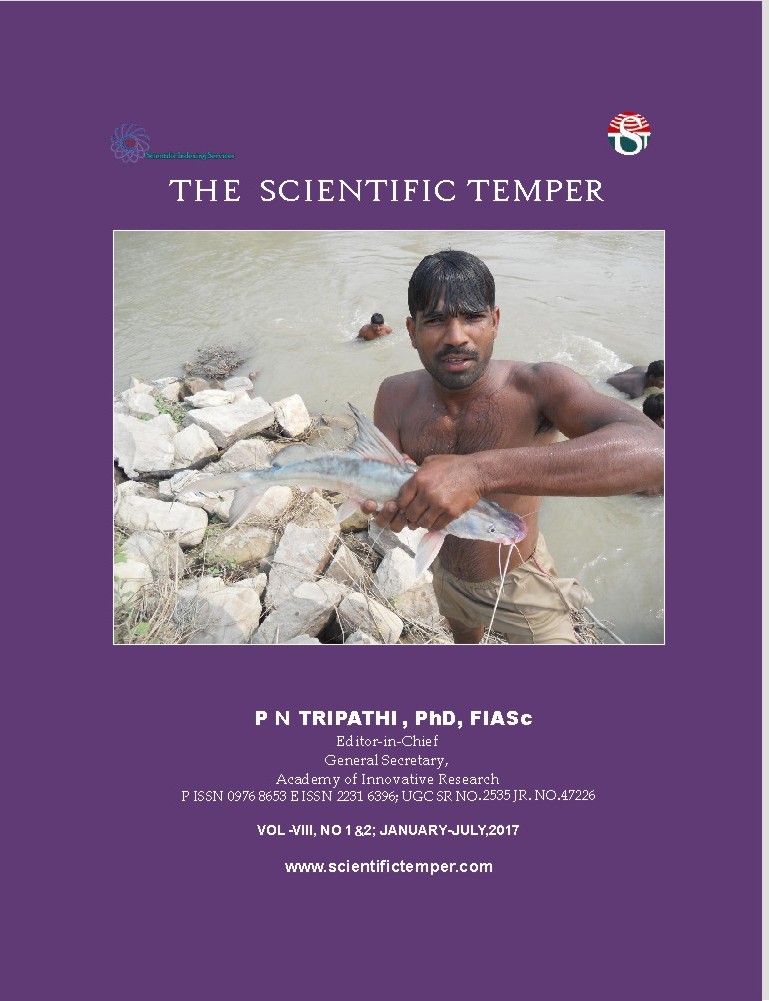
LENGTH-WEIGHT RELATIONSHIP OF FRESH WATER FISH LABEO BATA (HAM.) FROM RIVER GHAGHRA
Downloads
Published
DOI:
https://doi.org/10.58414/SCIENTIFICTEMPER.2017.08.1.06Keywords:
length-weight relationship, Labeo bataDimensions Badge
Issue
Section
License
Copyright (c) 2017 The Scientific Temper

This work is licensed under a Creative Commons Attribution-NonCommercial-ShareAlike 4.0 International License.
The length-weight relationship (LWR) was estimated in Labeo bata. It was observed that this fish did not follow the cube lawAbstract
strictly and the weight increased at a rate more than the cube of the length. The analysis of covariance did not show any significant
difference in the value of ‘n’ between the fishes of different size, sex and maturity stages in a population. The males were slightly heavier than females at smaller sizes and females were heavier than males at larger sizes and the two length - weight intersected at a point between 245 mm and 270 mm. This point of intersection represents the size at first maturity of the fish
How to Cite
Downloads
Similar Articles
- Sujay Bhalchandra, Nilesh D. Shinde, An exploratory study of factors influencing manufacturer-dealer relationship in Indian automobile industry , The Scientific Temper: Vol. 15 No. 02 (2024): The Scientific Temper
- V. Infine Sinduja, P. Joesph Charles, A hybrid approach using attention bidirectional gated recurrent unit and weight-adaptive sparrow search optimization for cloud load balancing , The Scientific Temper: Vol. 16 No. 05 (2025): The Scientific Temper
- Ramendra Kumar Dwivedi, Ved Prakash Tripathi, Nagendra Pratap Singh, P.N. Tripathi, Age and Growth Related Investigations on Major Carps in the Riverine Environment of River Ghaghra at and Around Faizabad , The Scientific Temper: Vol. 7 No. 1&2 (2016): THE SCIENTIFIC TEMPER
- Vinodini R, Ritha W, The economic order quantity model for sustainable green inventory considers deterioration impact on the real-time replacement and various reorder points with imperfect quality items , The Scientific Temper: Vol. 16 No. 04 (2025): The Scientific Temper
- RAMENDRA KUMAR DWIVEDI, PREM NARAYAN TRIPATHI, AGE AND GROWTH RELATIONSHIP OF CATLA CATLA IN AQUATIC ECOSYSTEM OF RIVER GHAGHRA AT AYODHYA , The Scientific Temper: Vol. 10 No. 1&2 (2019): The Scientific Temper
- S K Bairagi, Ram Chandra, R P Singh, Effect of Different Phosphorus and Potassium Levels on a Seed Crop of French Bean (Phaseolus vulgaris L.) , The Scientific Temper: Vol. 12 No. 1&2 (2021): The Scientific Temper
- Heikham G. Chanu, Sudha A. Raddi, Anita Dalal, Sangeeta N. Kharde, Shivani Tendulkar, Association between the socio-demographic variables of women admitted for delivery to a Tertiary Care Hospital and their maternal and neonatal outcome - A cross-sectional study , The Scientific Temper: Vol. 15 No. 01 (2024): The Scientific Temper
- KIRANDIMRI ., N. K. SHARMA, EFFECT OF ORGANIC FERTILIZERS ON SHOOT MORPHOLOGY OF ANACYCLUS PYRETHRUM IN THREE DIFFERENT ALTITUDES , The Scientific Temper: Vol. 10 No. 1&2 (2019): The Scientific Temper
- Rajni Mathur, Bharti Singh, Anjali Kalse, Veena R. Kolte, Saloni Desai, Sameer Sonawane, Examining the impact of economic cycles on India’s information technology sector , The Scientific Temper: Vol. 15 No. 01 (2024): The Scientific Temper
- Bayelign A. Zelalem, Ayalew A. Abebe, Evaluating supply chain management practice among micro and small manufacturing enterprise in southwest, Ethiopia , The Scientific Temper: Vol. 15 No. 02 (2024): The Scientific Temper
<< < 1 2 3 4 5 6 7 8 9 10 > >>
You may also start an advanced similarity search for this article.
Most read articles by the same author(s)
- ASHOK KUMAR, SADGURU PRAKASH, MARKANDEY MISHRA, MARIGOLD AS A TRAP CROP FOR THE MANAGEMENT OF TOMATO FRUIT BORER, HELICOVERPA ARMIGERA IN TARAI REGION OF UTTAR PRADESH , The Scientific Temper: Vol. 3 No. 1&2 (2012): The Scientific Temper