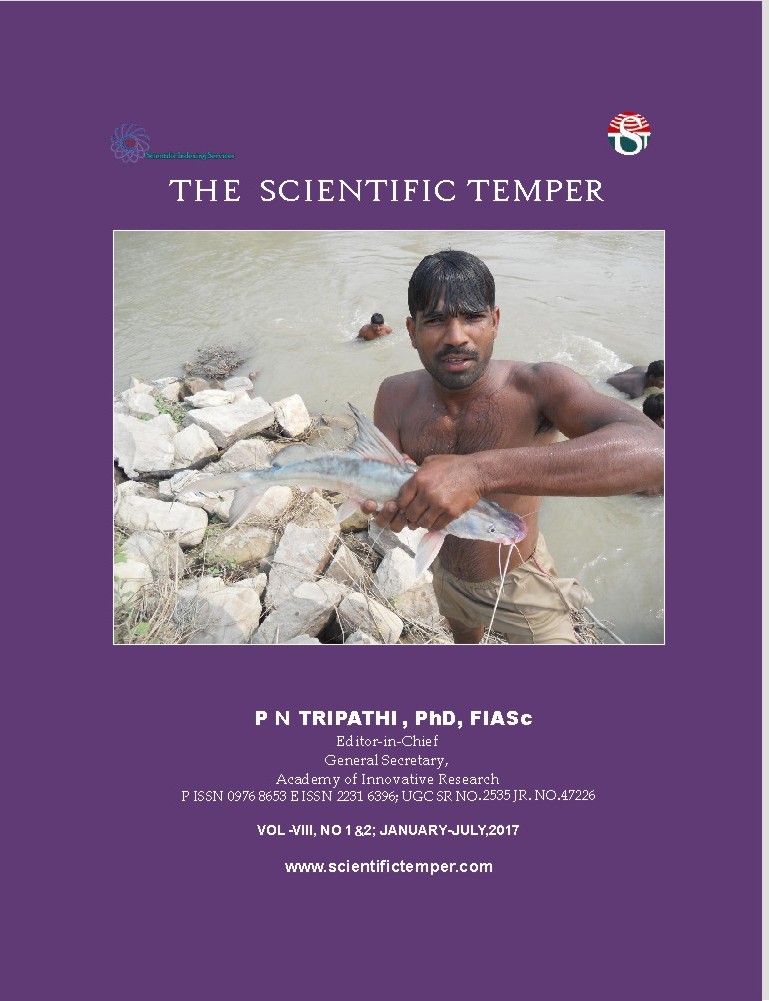
LENGTH-WEIGHT RELATIONSHIP OF FRESH WATER FISH LABEO BATA (HAM.) FROM RIVER GHAGHRA
Downloads
Published
DOI:
https://doi.org/10.58414/SCIENTIFICTEMPER.2017.08.1.06Keywords:
length-weight relationship, Labeo bataDimensions Badge
Issue
Section
License
Copyright (c) 2017 The Scientific Temper

This work is licensed under a Creative Commons Attribution-NonCommercial-ShareAlike 4.0 International License.
The length-weight relationship (LWR) was estimated in Labeo bata. It was observed that this fish did not follow the cube lawAbstract
strictly and the weight increased at a rate more than the cube of the length. The analysis of covariance did not show any significant
difference in the value of ‘n’ between the fishes of different size, sex and maturity stages in a population. The males were slightly heavier than females at smaller sizes and females were heavier than males at larger sizes and the two length - weight intersected at a point between 245 mm and 270 mm. This point of intersection represents the size at first maturity of the fish
How to Cite
Downloads
Similar Articles
- Basant Narain Singh, NITROGENOUS FERTILIZATION LEVELS AND ROOT MYCORRHIZAL COLONIZATION ON PLANT GROWTH AND PRODUCTIVITY IN WHEAT CROPS , The Scientific Temper: Vol. 9 No. 1&2 (2018): The Scientific Temper
- Belgundkar Babita, Kharde Sangeeta, Dodamani Suneel, Socio-demographic and reproductive determinants of spontaneous abortion- A cross-sectional comparative research at a tertiary care hospital in North Karnataka, India , The Scientific Temper: Vol. 15 No. 01 (2024): The Scientific Temper
- Shefali Bahadur, Rohit Kushwaha, M. Venkatesan, Ramya Singh, Manish Mishra, Strategic alignment in multispecialty hospitals: Implementing a balanced scorecard approach for optimal performance , The Scientific Temper: Vol. 15 No. 01 (2024): The Scientific Temper
- Jasmine A, G. Arul Selvi, Structural Relationships between Social Media Usage Patterns and Value Orientation among College-Going Youth in Rural and Urban Tamil Nadu: A Structural Equation Modelling Approach , The Scientific Temper: Vol. 17 No. 02 (2026): The Scientific Temper
- Rajesh Rayal, Alveena Saher , Pankaj Bahuguna, Shailza Negi, Study on Breeding Capacity of Snow Trout Schizothorax richardsonii (Gray) From River Yamuna, Uttarakhand, India , The Scientific Temper: Vol. 11 No. 1&2 (2020): The Scientific Temper
- Nikhil Kumar, Namita Kumar, Numerical Response of Campoletis chloridae Uchida (Hymenoptera: Ichneumonidae), a parasitoid of Heliothis armigera (Hubner) (Lepidoptera : Noctuidae) , The Scientific Temper: Vol. 12 No. 1&2 (2021): The Scientific Temper
- Lakshmi Priya, Anil Vasoya, C. Boopathi, Muthukumar Marappan, Evaluating dynamics, security, and performance metrics for smart manufacturing , The Scientific Temper: Vol. 14 No. 04 (2023): The Scientific Temper
- Deneshkumar V, Jebitha R, Jithu G, Multistate modeling for estimating clinical outcomes of COVID-19 patients , The Scientific Temper: Vol. 14 No. 04 (2023): The Scientific Temper
- Vikas Chaudhary, Parul Jhajharia, Mediation of competitive advantage between strategy management practices and organizational performance , The Scientific Temper: Vol. 15 No. 01 (2024): The Scientific Temper
- Urmi Chakravorty, Social media’s detrimental outcomes on personal relationships , The Scientific Temper: Vol. 15 No. 01 (2024): The Scientific Temper
<< < 5 6 7 8 9 10 11 12 13 > >>
You may also start an advanced similarity search for this article.
Most read articles by the same author(s)
- ASHOK KUMAR, SADGURU PRAKASH, MARKANDEY MISHRA, MARIGOLD AS A TRAP CROP FOR THE MANAGEMENT OF TOMATO FRUIT BORER, HELICOVERPA ARMIGERA IN TARAI REGION OF UTTAR PRADESH , The Scientific Temper: Vol. 3 No. 1&2 (2012): The Scientific Temper