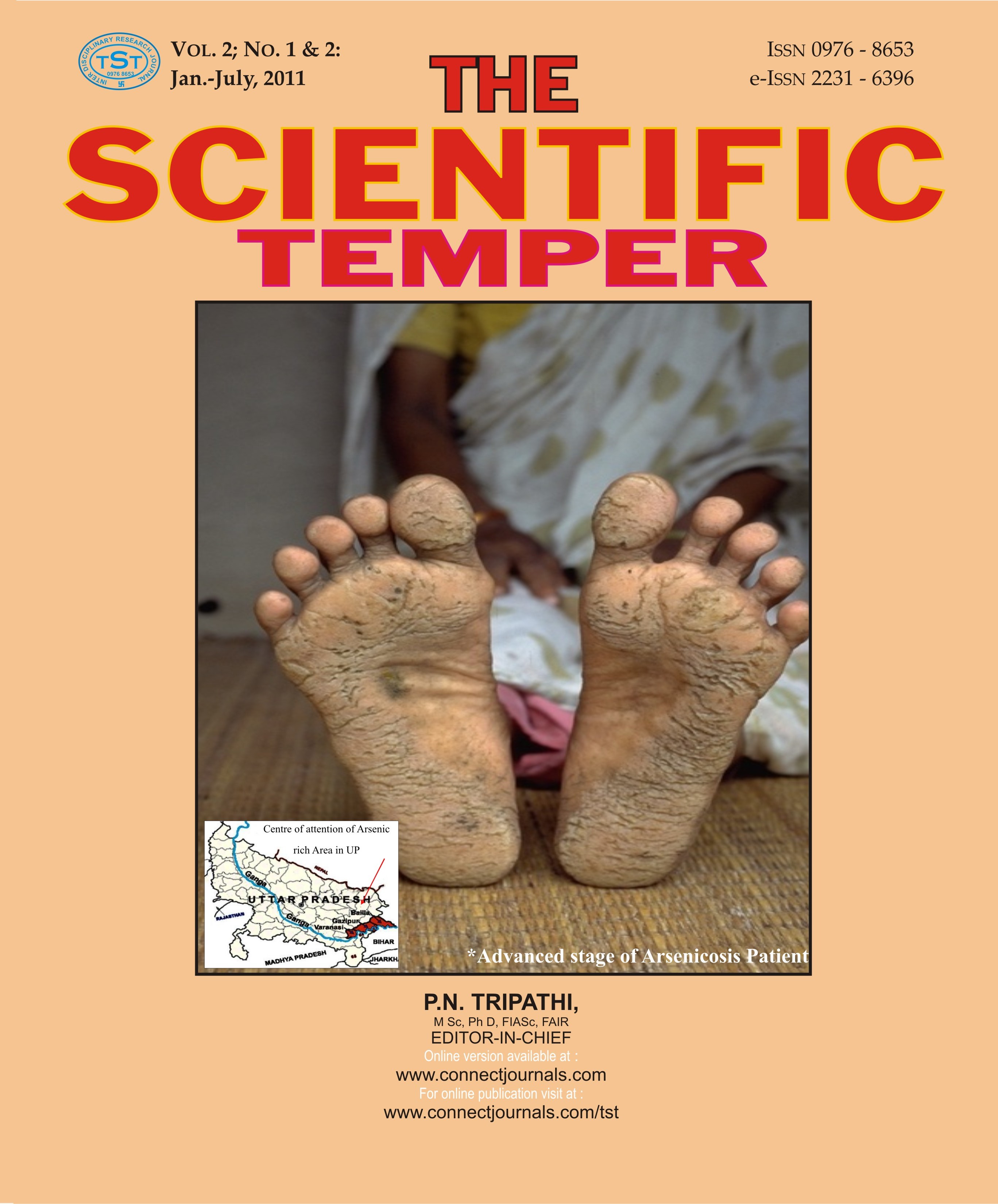
ARSENIC CONTAMINATION OF GROUND WATER IN ENDEMIC AREA OF UTTAR PRADESH: A CASE STUDY
Downloads
Published
DOI:
https://doi.org/10.58414/SCIENTIFICTEMPER.2011.02.1.15Keywords:
Ground water, Physico-chemical Properties, BIS, Ballia, RemediationDimensions Badge
Issue
Section
License
Copyright (c) 2011 The Scientific Temper

This work is licensed under a Creative Commons Attribution-NonCommercial-ShareAlike 4.0 International License.
In recent years much attention is being paid to explore the correlation of varying factors to ground water arsenic poisons. Herein, this has been investigated that ground water samples of Ballia (U.P) meet to exceed the Bureau of Indian standard (BIS) limits for the arsenic and iron of these water samples provide evidence ample discrepancy with waste standards. Here, it was investigated that out of 150 selected sources of water,91 samples have all analyzed parameters beyond desirable limits and water from these sources can’t be used for drinking purpose without special treatment. The expected outcome of the present work is to explore the mobilization of arsenic in gangetic plains by correlating the various contributing factors in water arsenic poisonings and developing concern to initiate the remediation measures to tackle this present crisis in drinking water reclamation processAbstract
How to Cite
Downloads
Similar Articles
- Rama Shankar Dubey, M.A. Naidu, Ajay Kumar Shukla, Awadhesh Kumar Shukla, Manish Kumar, Sonia Verma, Pramod Kumar Mourya, Application of Bioactive Molecules in the Treatment and Management of Type-1 Diabetic Disease , The Scientific Temper: Vol. 13 No. 02 (2022): The Scientific Temper
- M. Rajalakshmi, V. Sulochana, Enhancing deep learning model performance in air quality classification through probabilistic hyperparameter tuning with tree-structured Parzen estimators , The Scientific Temper: Vol. 14 No. 04 (2023): The Scientific Temper
- P. John Robinson, P. Susai Alexander, Neural net influenced magdm problem with modified choquet integral aggregation operators and correlation coefficient for triangular fuzzy intuitionistic fuzzy sets , The Scientific Temper: Vol. 15 No. 03 (2024): The Scientific Temper
- Dhara B. Makwana, Adwait Mevada, Diversity and Green Synthesis of Various Metal Nanoparticles (MNPs) , The Scientific Temper: Vol. 16 No. 11 (2025): The Scientific Temper
- Manoj Kumar, A.K. Srivastava, Bioaccumulation of Heavy Metals in Some Tissues of Fish, Clarias batrachus Exposed to Sub-lethal Concentration of Nickel Sulphate and Potassium Dichromate , The Scientific Temper: Vol. 13 No. 01 (2022): The Scientific Temper
- Isreal Zewide, Wondwosen Wondimu, Melash Woldu, Kibnesh Admasu, Maize (Zea mays L.) Productivity as affected by different ratios of fertilizer (blended NPS) and inter row spacing at West Omo, South-West Ethiopia , The Scientific Temper: Vol. 14 No. 01 (2023): The Scientific Temper
- G. C. Sowparnika, D. A. Vijula, Modeling and control of boiler in thermal power plant using model reference adaptive control , The Scientific Temper: Vol. 15 No. 01 (2024): The Scientific Temper
- Sivasankar G. A, Study of hybrid fuel injectors for aircraft engines , The Scientific Temper: Vol. 14 No. 03 (2023): The Scientific Temper
- Arsha A, Jeena Pearl A, Qualitative Phytochemical Profiling of Amaranthus Dubius Leaves , The Scientific Temper: Vol. 16 No. 09 (2025): The Scientific Temper
- Vijay Shankar Pandey, Abdul Kalam, PATHOGENICITY OF THE BACTERIAL ISOLATE AEROMONAS HYDROPHILA TO FISHES IN LABORATORY CONDITIONS , The Scientific Temper: Vol. 8 No. 1&2 (2017): The Scientific Temper
<< < 10 11 12 13 14 15 16 17 18 19 > >>
You may also start an advanced similarity search for this article.