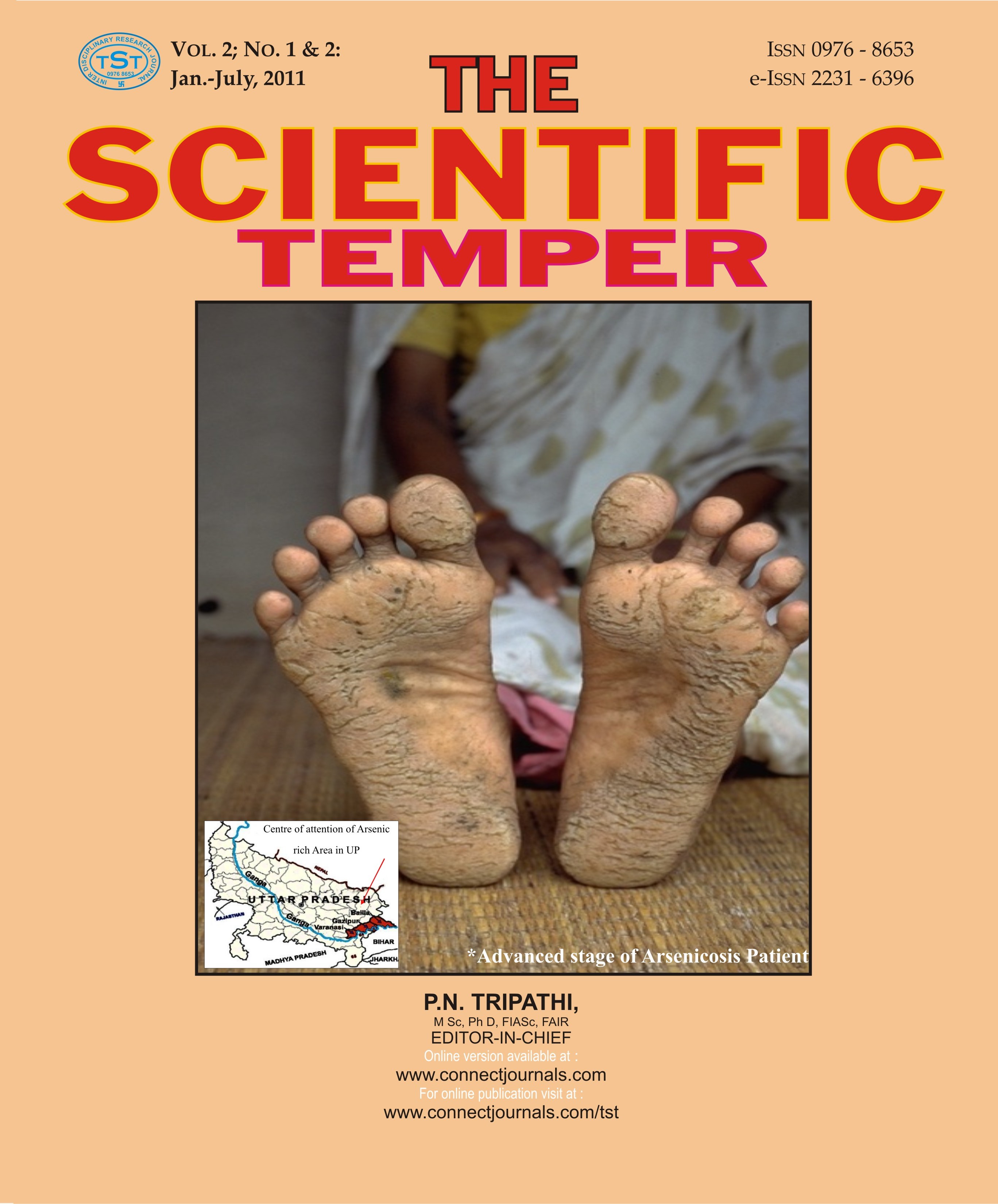
ARSENIC CONTAMINATION OF GROUND WATER IN ENDEMIC AREA OF UTTAR PRADESH: A CASE STUDY
Downloads
Published
DOI:
https://doi.org/10.58414/SCIENTIFICTEMPER.2011.02.1.15Keywords:
Ground water, Physico-chemical Properties, BIS, Ballia, RemediationDimensions Badge
Issue
Section
License
Copyright (c) 2011 The Scientific Temper

This work is licensed under a Creative Commons Attribution-NonCommercial-ShareAlike 4.0 International License.
In recent years much attention is being paid to explore the correlation of varying factors to ground water arsenic poisons. Herein, this has been investigated that ground water samples of Ballia (U.P) meet to exceed the Bureau of Indian standard (BIS) limits for the arsenic and iron of these water samples provide evidence ample discrepancy with waste standards. Here, it was investigated that out of 150 selected sources of water,91 samples have all analyzed parameters beyond desirable limits and water from these sources can’t be used for drinking purpose without special treatment. The expected outcome of the present work is to explore the mobilization of arsenic in gangetic plains by correlating the various contributing factors in water arsenic poisonings and developing concern to initiate the remediation measures to tackle this present crisis in drinking water reclamation processAbstract
How to Cite
Downloads
Similar Articles
- Vishal Panghal, Asha Singh, Dinesh Arora, Nidhi Ahlawat, Sunder S. Arya, Sunil Kumar, Horizontal flow biochar amended constructed wetlands as a sustainable approach for rural wastewater treatment , The Scientific Temper: Vol. 15 No. 03 (2024): The Scientific Temper
- Deepesh Bhardwaj, Niyati Chaudhary, Blueprints of Green: Determining Key Determinants of Sustainable Real Estate Projects in Delhi NCR , The Scientific Temper: Vol. 17 No. 01 (2026): The Scientific Temper
- Neha Saini, Pallavi Upadhyay, Naitik Bhardwaj, Indra Rautela, Ashmita Bhatt, Nishima Sharma, Jyoti Barthwal, Prity Kumari, Naveen Gaurav, Establishment of in vitro Shoot Induction and an Evaluation of Antioxidant and Phytochemical Properties of Mucuna pruriens , The Scientific Temper: Vol. 13 No. 01 (2022): The Scientific Temper
- Prem Yadav, Prashant Kumar, CLIMATE CHANGE AND BIODIVERSITY IN NARAYANI RIVER ECOSYSTEM AND ECOSYSTEM SERVICES , The Scientific Temper: Vol. 9 No. 1&2 (2018): The Scientific Temper
- Shalini Tiwari, To Explore the Salt Stress Responsive Long Non-coding RNA(s) Mechanism in Contrasting Rice (Oryza stiva L.) Genotypes , The Scientific Temper: Vol. 13 No. 02 (2022): The Scientific Temper
- N Harini, N Santhi, Challenges and opportunities in product development using natural dyes , The Scientific Temper: Vol. 14 No. 01 (2023): The Scientific Temper
- Ajay Kumar, Sunder S. Arya, Neha Yadav, Mamta Sawariya, Naveen Kumar, Himanshu Mehra, Sunil Kumar, Assessing the role of EDTA and SA in mustard under Cd and Pb stress , The Scientific Temper: Vol. 15 No. 01 (2024): The Scientific Temper
- Anupam Sinha, Rhizome Rot Disease of Ginger (Zingiber officinale Rosc.) and its Bio-control Strategy , The Scientific Temper: Vol. 11 No. 1&2 (2020): The Scientific Temper
- S. Manohar, T. P. Vijayakumar, Optimization of gluten-free bread using RSM (Design Expert) to study its textural and sensory properties , The Scientific Temper: Vol. 14 No. 04 (2023): The Scientific Temper
- P. Rajkumar, B. Vijay Bhaskar, Assessing the impact of indoor air pollution on respiratory health: A survey of home residents in rural area , The Scientific Temper: Vol. 15 No. 03 (2024): The Scientific Temper
<< < 9 10 11 12 13 14 15 16 17 18 > >>
You may also start an advanced similarity search for this article.