Diurnal and seasonal variation of GPS-TEC during a low solar activity period at EIA region (Bhopal)
Downloads
Published
DOI:
https://doi.org/10.58414/SCIENTIFICTEMPER.2024.15.2.16Keywords:
Keywords: Total Electron Content (TEC); Equatorial Ionization Anomaly (EIA); Global Positioning System (GPS); Solar Indices; Electron Electrojet (EEJ).Dimensions Badge
Issue
Section
License
Copyright (c) 2024 The Scientific Temper

This work is licensed under a Creative Commons Attribution-NonCommercial-ShareAlike 4.0 International License.
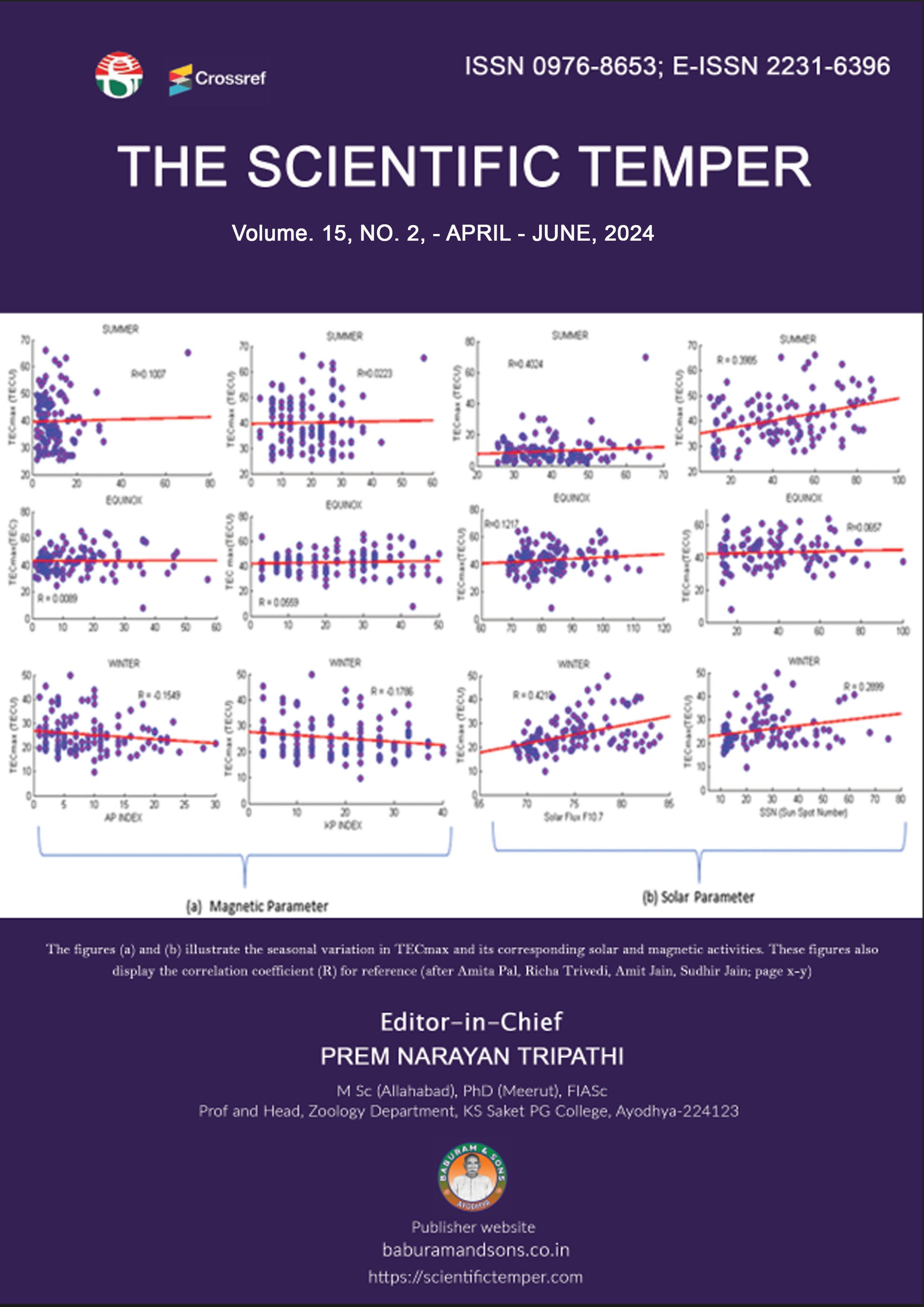
The ionosphere near the equatorial ionization anomaly crest region in the Indian ionospheric sector was studied from May 2016 to April 2017, a solar minimum period. Total electron content (TEC) recorded using the multiple frequency GPS receivers at Bhopal (23.2° N, 77.4° E & MLAT 14.2° N) is used for the study. The diurnal variation shows that the day minimum in TEC is attained around 06:00 hours LT, and the day maximum occurs at about 16:00 hours LT. A similar diurnal pattern was observed in all months across various seasons. During the period of study, it was observed that Seasonal variation of TEC was minimal in winter, whereas highest during equinox and summer months. The variation of TECmax with EEJ shows a positive correlation between the parameters for all the months. The highest correlation (0.8398) was observed in January 2017, while it was lowest (0.4004) in March 2017 and the results were compared with earlier observations, and a possible mechanism was discussed.Abstract
How to Cite
Downloads
Similar Articles
- Christina Parmar, Dipak Makwana, Nita Vaghela, Professional Social Work Interventions in Healthcare: Safeguarding Patient Rights and Strengthening Grievance Redressal Systems , The Scientific Temper: Vol. 17 No. 03 (2026): The Scientific Temper
- Rashmi Rani, ROLE OF NEUROTICISM AND EXTRAVERSION FACTORS OF PERSONALITY ON LIFE SATISFACTION IN MARRIED COUPLES , The Scientific Temper: Vol. 8 No. 1&2 (2017): The Scientific Temper
- Pallavi Dheer, Aditi Sharma, Mallika Joshi, Rajesh Rayal, Indra Rautela, Rakesh Rai, Narotam Sharma, Serological and Biochemical Profiling of Pandemic Dengue Virus in Clinical Isolates During An Outbreak in Dehradun Region , The Scientific Temper: Vol. 12 No. 1&2 (2021): The Scientific Temper
- Atal Bihari Bajpai, Nirmala Koranga, Naina Srivastava, Avadhesh Kumar Koshal, Krishan Pal Singh Rana, Diversity of Wild Edible Plants in the Kotla Valley in Uttarkashi, Uttarakhand, India , The Scientific Temper: Vol. 13 No. 02 (2022): The Scientific Temper
- Rashmika Vaghela, Dileep Labana, Kirit Modi, Efficient I3D-VGG19-based architecture for human activity recognition , The Scientific Temper: Vol. 14 No. 04 (2023): The Scientific Temper
- Shubharani Muragod, Sangeeta Kharde, Premenstrual syndrome among adolescent girls and its influence on academic performance- A cross-sectional study , The Scientific Temper: Vol. 14 No. 04 (2023): The Scientific Temper
- Z. Admasu, E. Bayou, Current population size and risk status of the indigenous endangered Sheko cattle breed in south-west Ethiopia , The Scientific Temper: Vol. 15 No. 02 (2024): The Scientific Temper
- Priya Nandhagopal, Jayasimman Lawrence, ETTG: Enhanced token and tag generation for authenticating users and deduplicating data stored in public cloud storage , The Scientific Temper: Vol. 15 No. 03 (2024): The Scientific Temper
- S. Sindhu, L. Arockiam, A lightweight selective stacking framework for IoT crop recommendation , The Scientific Temper: Vol. 15 No. 04 (2024): The Scientific Temper
- Aakanksha Laiker, Promil Pande, Contribution of policy and regulations to enhance Transparency and Traceability in the Garment Industry , The Scientific Temper: Vol. 15 No. spl-2 (2024): The Scientific Temper
<< < 33 34 35 36 37 38 39 40 41 42 > >>
You may also start an advanced similarity search for this article.