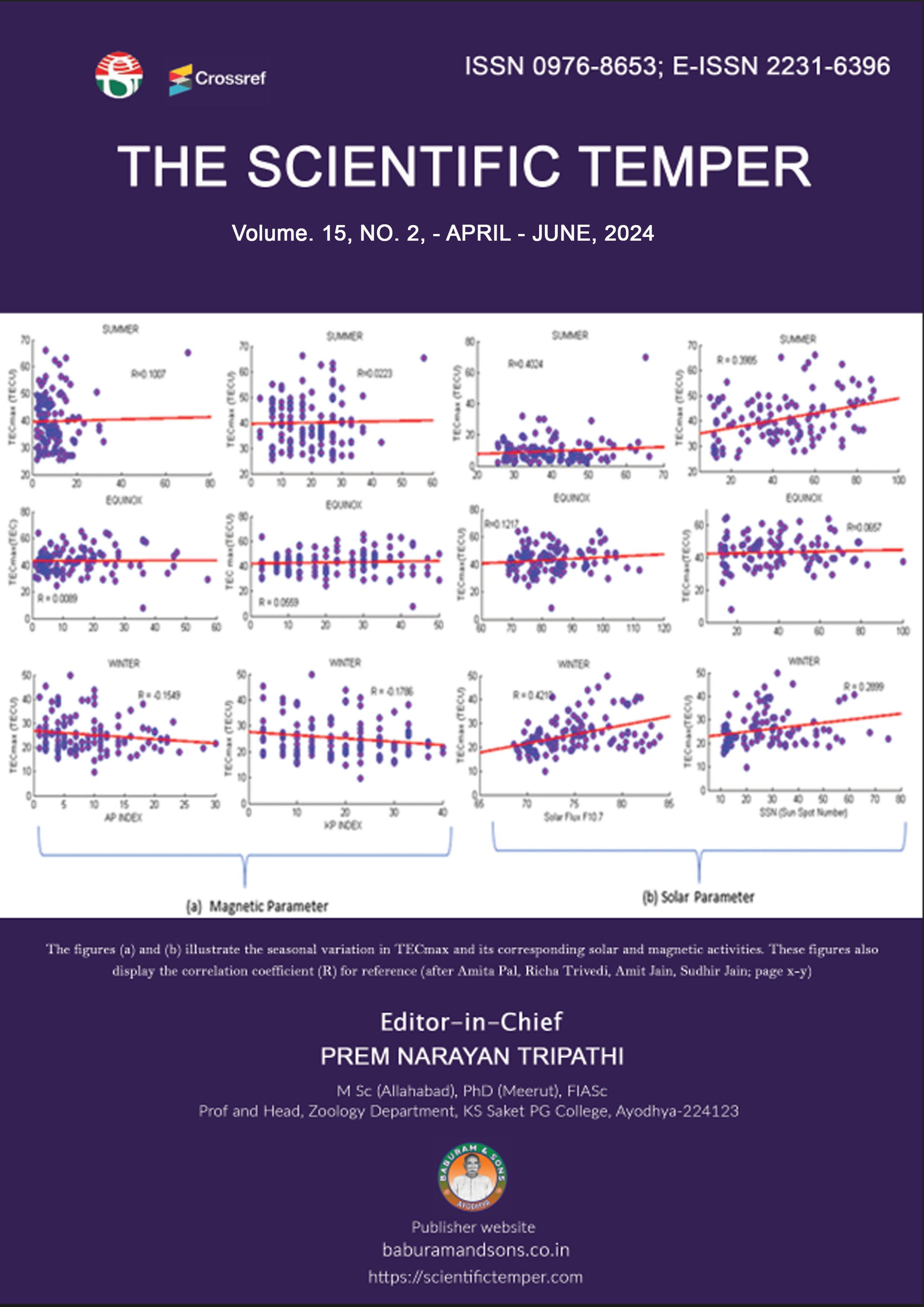
Diurnal and seasonal variation of GPS-TEC during a low solar activity period at EIA region (Bhopal)
Downloads
Published
DOI:
https://doi.org/10.58414/SCIENTIFICTEMPER.2024.15.2.16Keywords:
Keywords: Total Electron Content (TEC); Equatorial Ionization Anomaly (EIA); Global Positioning System (GPS); Solar Indices; Electron Electrojet (EEJ).Dimensions Badge
Issue
Section
License
Copyright (c) 2024 The Scientific Temper

This work is licensed under a Creative Commons Attribution-NonCommercial-ShareAlike 4.0 International License.
The ionosphere near the equatorial ionization anomaly crest region in the Indian ionospheric sector was studied from May 2016 to April 2017, a solar minimum period. Total electron content (TEC) recorded using the multiple frequency GPS receivers at Bhopal (23.2° N, 77.4° E & MLAT 14.2° N) is used for the study. The diurnal variation shows that the day minimum in TEC is attained around 06:00 hours LT, and the day maximum occurs at about 16:00 hours LT. A similar diurnal pattern was observed in all months across various seasons. During the period of study, it was observed that Seasonal variation of TEC was minimal in winter, whereas highest during equinox and summer months. The variation of TECmax with EEJ shows a positive correlation between the parameters for all the months. The highest correlation (0.8398) was observed in January 2017, while it was lowest (0.4004) in March 2017 and the results were compared with earlier observations, and a possible mechanism was discussed.Abstract
How to Cite
Downloads
Similar Articles
- A. Sandanasamy, P. Joseph Charles, Distributed SDN control for IoT networks: A federated meta reinforcement learning solution for load balancing , The Scientific Temper: Vol. 16 No. 06 (2025): The Scientific Temper
- Sweta Sain, Nilima Kumari, BN Tirpathi, ETHNOBOTANICAL STUDIES ON MEDICINAL PLANTS OF BANASTHALI REGION OF TONK DISTRICT, RAJASTHAN (INDIA) , The Scientific Temper: Vol. 8 No. 1&2 (2017): The Scientific Temper
- Rama Shankar Dubey, M.A. Naidu, Ajay Kumar Shukla, Awadhesh Kumar Shukla, Manish Kumar, Sonia Verma, Pramod Kumar Mourya, Application of Bioactive Molecules in the Treatment and Management of Type-1 Diabetic Disease , The Scientific Temper: Vol. 13 No. 02 (2022): The Scientific Temper
- Sreenath M.V. Reddy, D. Annapurna, Anand Narasimhamurthy, Influence node analysis based on neighborhood influence vote rank method in social network , The Scientific Temper: Vol. 14 No. 04 (2023): The Scientific Temper
- T. Ramyaveni, V. Maniraj, Hyperparameter tuning of diabetes prediction using machine learning algorithm with pelican optimization algorithm , The Scientific Temper: Vol. 15 No. 03 (2024): The Scientific Temper
- Manan Pathak, Dishang Trivedi Trivedi, Field-effect limits and design parameters for hybrid HVDC – HVAC transmission line corridors , The Scientific Temper: Vol. 16 No. Spl-1 (2025): The Scientific Temper
- Nalini. S, Ritha. W, Sasitharan Nagapan, Economic Order Quantity under Perishability: Analytical and Iterative Approaches to Cost Minimization , The Scientific Temper: Vol. 16 No. 09 (2025): The Scientific Temper
- Hardik Talsania, Kirit Modi, Attention-Enhanced Multi-Modal Machine Learning for Cardiovascular Disease Diagnosis , The Scientific Temper: Vol. 17 No. 01 (2026): The Scientific Temper
- V.K. Pandey, R.N. Mishra, Shipra Upadhyaya, Anand Swaroop, TOXICITY OF PAPER MILL EFFLUENTS EFFECTS LIVER PROTEIN AND AMINO ACID DURING ANNUAL BREEDING CYCLE OF HETEROPNEUSTES FOSSILIS (BLOCH) , The Scientific Temper: Vol. 1 No. 01 (2010): The Scientific Temper
- Suman Saurabh, Prashant Kumar, CLIMATE CHANGE EFFECTS ON AQUATIC ECOSYSTEM: STRUCTURE AND DISEASE , The Scientific Temper: Vol. 9 No. 1&2 (2018): The Scientific Temper
<< < 34 35 36 37 38 39 40 41 42 43 > >>
You may also start an advanced similarity search for this article.