
Comparative Study on SARS-CoV-2 Variants
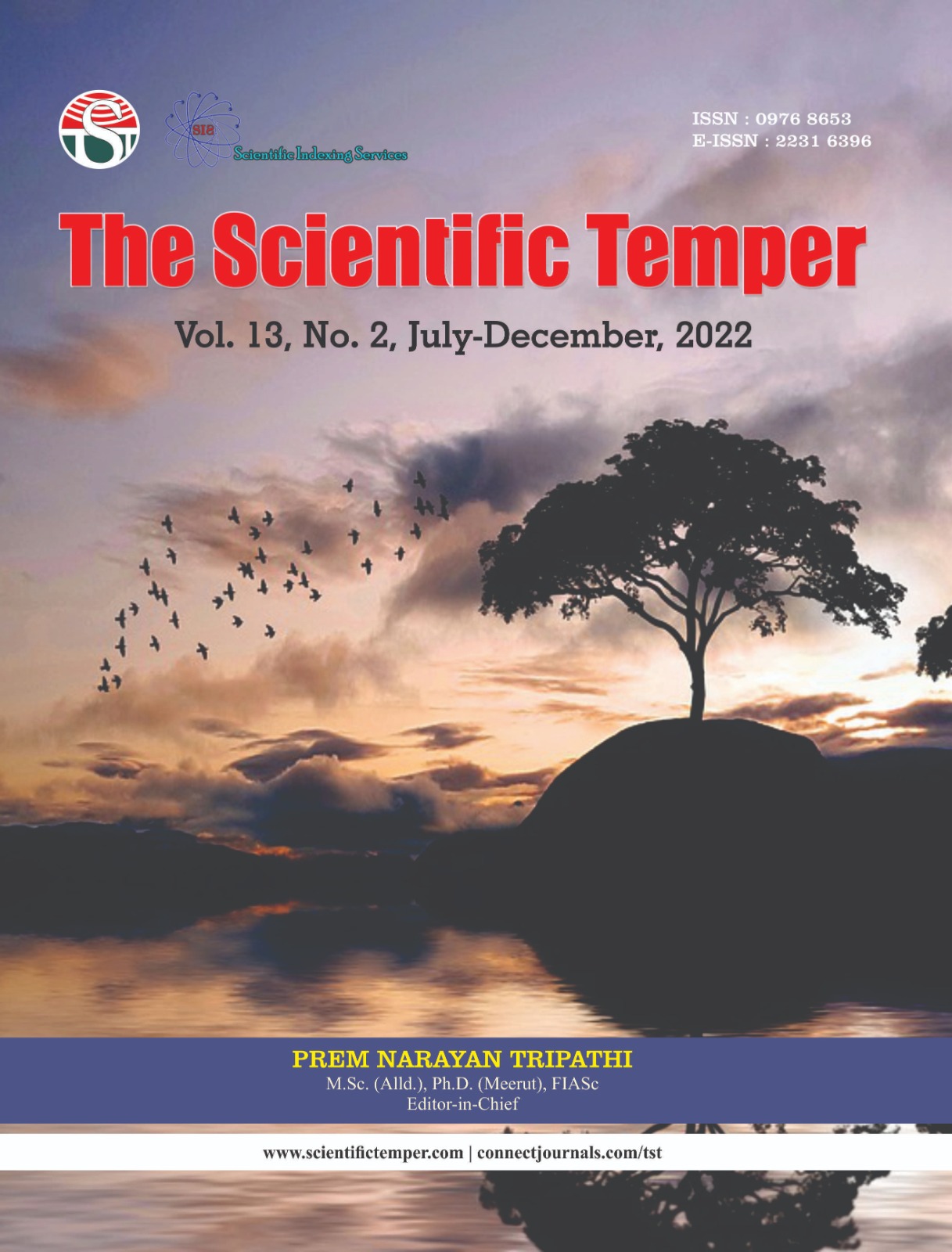
Downloads
Published
DOI:
https://doi.org/10.58414/SCIENTIFICTEMPER.2022.13.2.09Keywords:
SARS-CoV-2 variants, research study,VOI,VOCDimensions Badge
Issue
Section
License
Copyright (c) 2022 The Scientific Temper

This work is licensed under a Creative Commons Attribution-NonCommercial-ShareAlike 4.0 International License.
Viruses have spent billions of years perfecting the art of surviving without living, a frighteningly effective strategy that makes them a potent threat in today’s world. But as soon as it gets into a human airway, the virus hijacks our cells to create millions more versions of itself. That’s especially true of the deadly new coronavirus that has brought global society to a screeching halt. It’s little more than a packet of genetic material surrounded by a spiky protein shell onethousandth the width of an eyelash, and it leads such a zombielike existence that it’s barely considered a living organism. A comparative research study survey on Male and Female Post Graduate of Chemistry residing in Mumbai and its suburbs was conducted to find out their awareness regarding SARS-CoV-2 virus and its variants. In the research study survey, it was found that students were not fully aware of the situation and the various factors associated with SARS-CoV-2 and its variants. There is an urgent need to make people educate on this matter so that if and when the next pandemic occurs we should know our way out.Abstract
How to Cite
Downloads
Similar Articles
- Kumar Sanu, Equabal Jawaid, POND EUTROPHICATION AND FOOD TYPE AS DETERMINANT OF GROWTH AND SURVIVAL IN Clarias batrachus (LINN.) , The Scientific Temper: Vol. 9 No. 1&2 (2018): The Scientific Temper
- Neeraj, Anita Singhrova, A critical review of blockchain-based authentication techniques , The Scientific Temper: Vol. 16 No. 04 (2025): The Scientific Temper
- Nikhil Kumar, Namita Kumar, Numerical Response of Campoletis chloridae Uchida (Hymenoptera: Ichneumonidae), a parasitoid of Heliothis armigera (Hubner) (Lepidoptera : Noctuidae) , The Scientific Temper: Vol. 12 No. 1&2 (2021): The Scientific Temper
- Kumari Neha, Amrita ., Quantum programming: Working with IBM’S qiskit tool , The Scientific Temper: Vol. 14 No. 01 (2023): The Scientific Temper
- Namita R. Behera, A Study on credit facilities of micro, small, and medium enterprises at Syndicate Bank , The Scientific Temper: Vol. 14 No. 04 (2023): The Scientific Temper
- K. Vani, S. Sujatha, Fault tolerance systems in open source cloud computing environments–A systematic review , The Scientific Temper: Vol. 14 No. 03 (2023): The Scientific Temper
- Bajeesh Balakrishnan, Swetha A. Parivara, E-HRM: Learning approaches, applications and the role of artificial intelligence , The Scientific Temper: Vol. 14 No. 04 (2023): The Scientific Temper
- Rohit Chettri, Prem Kumar N, Renoprotective effect of flavonoids in type-2 diabetes mediated-nephropathy in Wistar rats , The Scientific Temper: Vol. 15 No. 04 (2024): The Scientific Temper
- AMITESH KUMAR, R.K. VERMA, AN EVALUATION OF SUPER-FLUID DENSITY s AS A FUNCTION OF c T T FOR BCS-BEC CROSSOVER REGIME , The Scientific Temper: Vol. 10 No. 1&2 (2019): The Scientific Temper
- K. Hima Bindu, How can India strengthen mental health services as part of its efforts to promote holistic wellbeing by 2047 , The Scientific Temper: Vol. 16 No. Spl-1 (2025): The Scientific Temper
<< < 65 66 67 68 69 70 71 72 73 74 > >>
You may also start an advanced similarity search for this article.
Most read articles by the same author(s)
- P N Tripathi, Ved Prakash Tripathi, Swapnil Raj Dubey, Conservation Needs of Freshwater Fin-Fish Genetic Resources , The Scientific Temper: Vol. 7 No. 1&2 (2016): THE SCIENTIFIC TEMPER
- P N TRIPATHI, EVALUATION OF SILKWORM RACES/HYBRIDS FOR CULTRE AT FARMERS’ LEVEL IN UTTAR PRADESH: APPROPRIATE TECHNIQUES , The Scientific Temper: Vol. 8 No. 1&2 (2017): The Scientific Temper

