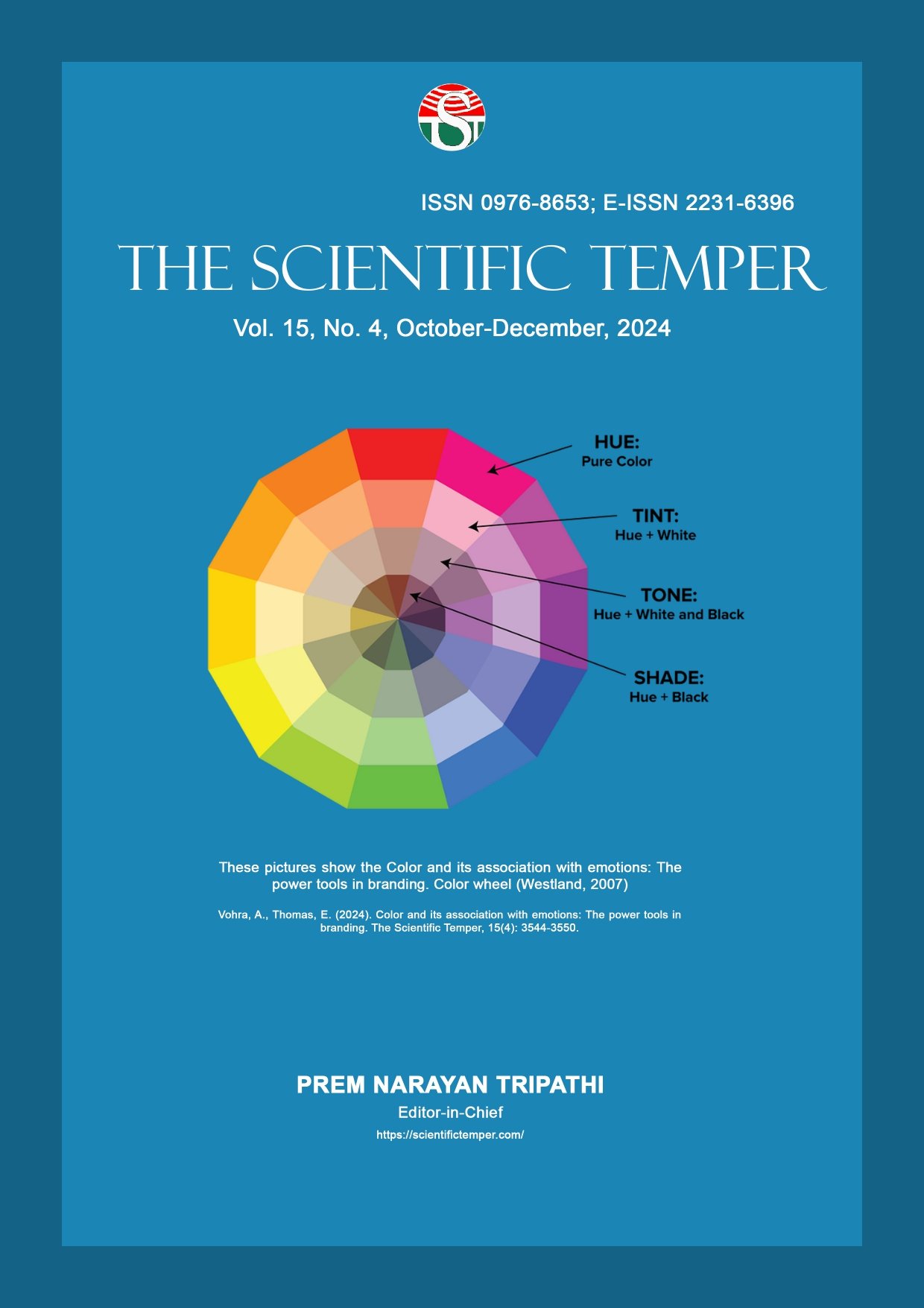
Color and its association with emotions: The power tools in branding
Downloads
Published
DOI:
https://doi.org/10.58414/SCIENTIFICTEMPER.2024.15.4.65Keywords:
Branding, Color psychology, Colors in branding, Emotions, Emotional brandingDimensions Badge
Issue
Section
License
Copyright (c) 2024 The Scientific Temper

This work is licensed under a Creative Commons Attribution-NonCommercial-ShareAlike 4.0 International License.
Branding is essential for businesses because it helps create a unique identity and personality for a company, product, or service. The utilization of color and its psychological implications hold substantial influence in the field of branding, as it possesses the potential to significantly impact consumers' emotions and their overall perceptions of a brand. Different colors have the potential to elicit distinct emotional responses and exert an impact on the way consumers interpret the personality and values associated with a brand. By using colors strategically, brands can explain and justify the message more articulately and precisely and create a compelling emotional connection with their audience, while helping businesses to stand out in a crowded marketplace, as a unique and memorable color scheme can differentiate them from their competitors. This conceptual study seeks to identify emotions related to specific colors as a tool to strengthen a brand stating multiple examples of the color Black in products and why consumers get attracted to these specific brands. The findings of this study are directed toward marketers and scholars for a further understanding of how branding and color psychology are substantially related.Abstract
How to Cite
Downloads
Similar Articles
- Reshmi J S, Sandhya S, Ahir embroidery of Kutch , The Scientific Temper: Vol. 14 No. 02 (2023): The Scientific Temper
- S. Joshitha, A. Yakshitha, Mariyam Adnan, Diversification and application of Warli art on apparels , The Scientific Temper: Vol. 14 No. 02 (2023): The Scientific Temper
- Rajeshwar Mukherjee, Uday S. Dixit, Understanding cosmopsychism based on stochastic electrodynamics from the perspective of the Indian knowledge system , The Scientific Temper: Vol. 14 No. 03 (2023): The Scientific Temper
- Pankaj Kumar, Ambrish Pandey, Rajendrakumar Anayath, Study of print suitability of environment-friendly plastics using flexography printing , The Scientific Temper: Vol. 15 No. 01 (2024): The Scientific Temper
- Urmi Chakravorty, Social media’s detrimental outcomes on personal relationships , The Scientific Temper: Vol. 15 No. 01 (2024): The Scientific Temper
- Shubharani Muragod, Sangeeta Kharde, Premenstrual syndrome among adolescent girls and its influence on academic performance- A cross-sectional study , The Scientific Temper: Vol. 14 No. 04 (2023): The Scientific Temper
- Sawitri Devi, Raj Kumar, Unveiling scholarly insights: A bibliometric analysis of literature on gender bias at the workplace , The Scientific Temper: Vol. 15 No. 03 (2024): The Scientific Temper
- J. B. BHEDA, Comparative study of classical oratory traditions in East and West , The Scientific Temper: Vol. 15 No. 02 (2024): The Scientific Temper
- Muhammed Jouhar K. K., K. Aravinthan, A bigdata analytics method for social media behavioral analysis , The Scientific Temper: Vol. 15 No. 03 (2024): The Scientific Temper
- Roop Kanwal, Children’s literature as a tool for social change: Teaching values and social awareness , The Scientific Temper: Vol. 15 No. spl-2 (2024): The Scientific Temper
You may also start an advanced similarity search for this article.
Most read articles by the same author(s)
- Sharanya Unnikrishnan, Eldhose Thomas, Arunima Dey, AI-Powered NLP in Vernacular Public Relations: Opportunities, Challenges, and Ethical Implications for India’s Multilingual Landscape , The Scientific Temper: Vol. 16 No. 10 (2025): The Scientific Temper