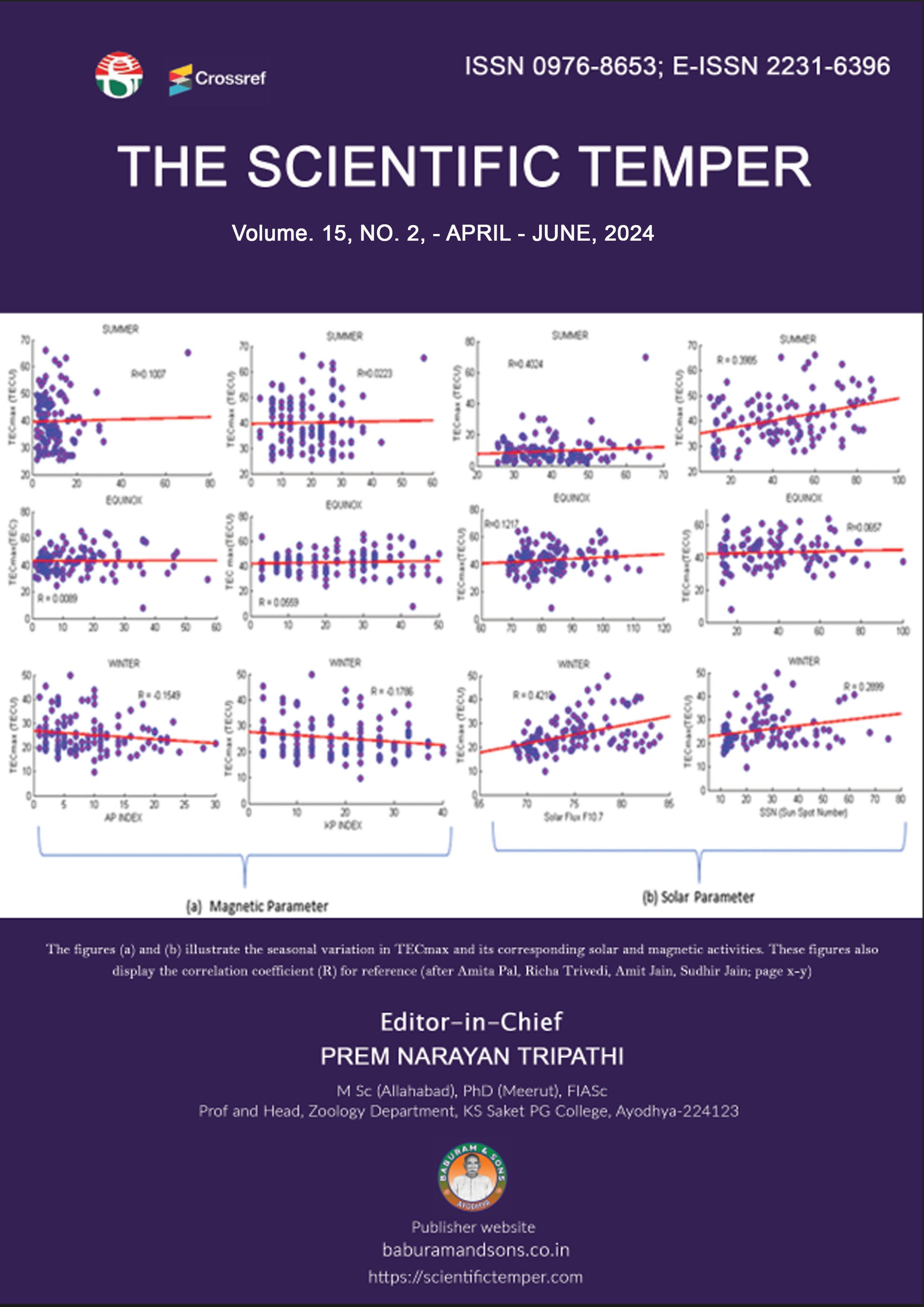
Diurnal and seasonal variation of GPS-TEC during a low solar activity period at EIA region (Bhopal)
Downloads
Published
DOI:
https://doi.org/10.58414/SCIENTIFICTEMPER.2024.15.2.16Keywords:
Keywords: Total Electron Content (TEC); Equatorial Ionization Anomaly (EIA); Global Positioning System (GPS); Solar Indices; Electron Electrojet (EEJ).Dimensions Badge
Issue
Section
License
Copyright (c) 2024 The Scientific Temper

This work is licensed under a Creative Commons Attribution-NonCommercial-ShareAlike 4.0 International License.
The ionosphere near the equatorial ionization anomaly crest region in the Indian ionospheric sector was studied from May 2016 to April 2017, a solar minimum period. Total electron content (TEC) recorded using the multiple frequency GPS receivers at Bhopal (23.2° N, 77.4° E & MLAT 14.2° N) is used for the study. The diurnal variation shows that the day minimum in TEC is attained around 06:00 hours LT, and the day maximum occurs at about 16:00 hours LT. A similar diurnal pattern was observed in all months across various seasons. During the period of study, it was observed that Seasonal variation of TEC was minimal in winter, whereas highest during equinox and summer months. The variation of TECmax with EEJ shows a positive correlation between the parameters for all the months. The highest correlation (0.8398) was observed in January 2017, while it was lowest (0.4004) in March 2017 and the results were compared with earlier observations, and a possible mechanism was discussed.Abstract
How to Cite
Downloads
Similar Articles
- Sowmiya M, Banu Rekha B, Malar E, Ensemble classifiers with hybrid feature selection approach for diagnosis of coronary artery disease , The Scientific Temper: Vol. 14 No. 03 (2023): The Scientific Temper
- Ratnakaram Raghavendra, Saila K. A. Reddy, Exploring cosmic ray energy loss mechanisms: Insights from Bethe-Bloch, modified bethe-bloch, and inverse compton scattering equations , The Scientific Temper: Vol. 15 No. 02 (2024): The Scientific Temper
- Roopesh K R, Jyothi Y, Manisha Bihani, Chandini C H, Nishanth D R, Maheshkumar Hondale, Sairashmi Samanta, Karthik G, Anu M, Neuroprotective effect of alcoholic extract of Selaginella bryopteris leaves in experimental models of epilepsy , The Scientific Temper: Vol. 15 No. 04 (2024): The Scientific Temper
- Aarthi Monalisa M, Anli Suresh, Adoptive bancassurance models transforming patronization among the insured , The Scientific Temper: Vol. 16 No. Spl-2 (2025): The Scientific Temper
- Pallavi M. Shimpi, Nitin N. Pise, Comparative Analysis of Machine Learning Algorithms for Malware Detection in Android Ecosystems , The Scientific Temper: Vol. 16 No. 11 (2025): The Scientific Temper
- S V Arulvani, Dr. C. Jayanthi, Logistic Elitist Liquid Neural Network For Student Dropout Prediction , The Scientific Temper: Vol. 17 No. 02 (2026): The Scientific Temper
- K. P. SINGH, NIDHI TRIPATHI, ANTIPSYCHOTIC MEDICATION DURING PREGNANCY AND POSSIBLE BIRTH DEFECTS , The Scientific Temper: Vol. 2 No. 1&2 (2011): The Scientific Temper
- Manisha Pallvi, Fish Diversity and Fish Assemblage Analysis in Shatiya Wetland of North Bihar , The Scientific Temper: Vol. 11 No. 1&2 (2020): The Scientific Temper
- Archana Bansal, On the Biology of Chrysomya megacephala (Fabricius) (Diptera: Calliphoridae) , The Scientific Temper: Vol. 13 No. 02 (2022): The Scientific Temper
- Pravin P. P, J. Arunshankar, Development of digital twin for PMDC motor control loop , The Scientific Temper: Vol. 14 No. 01 (2023): The Scientific Temper
<< < 38 39 40 41 42 43 44 45 > >>
You may also start an advanced similarity search for this article.