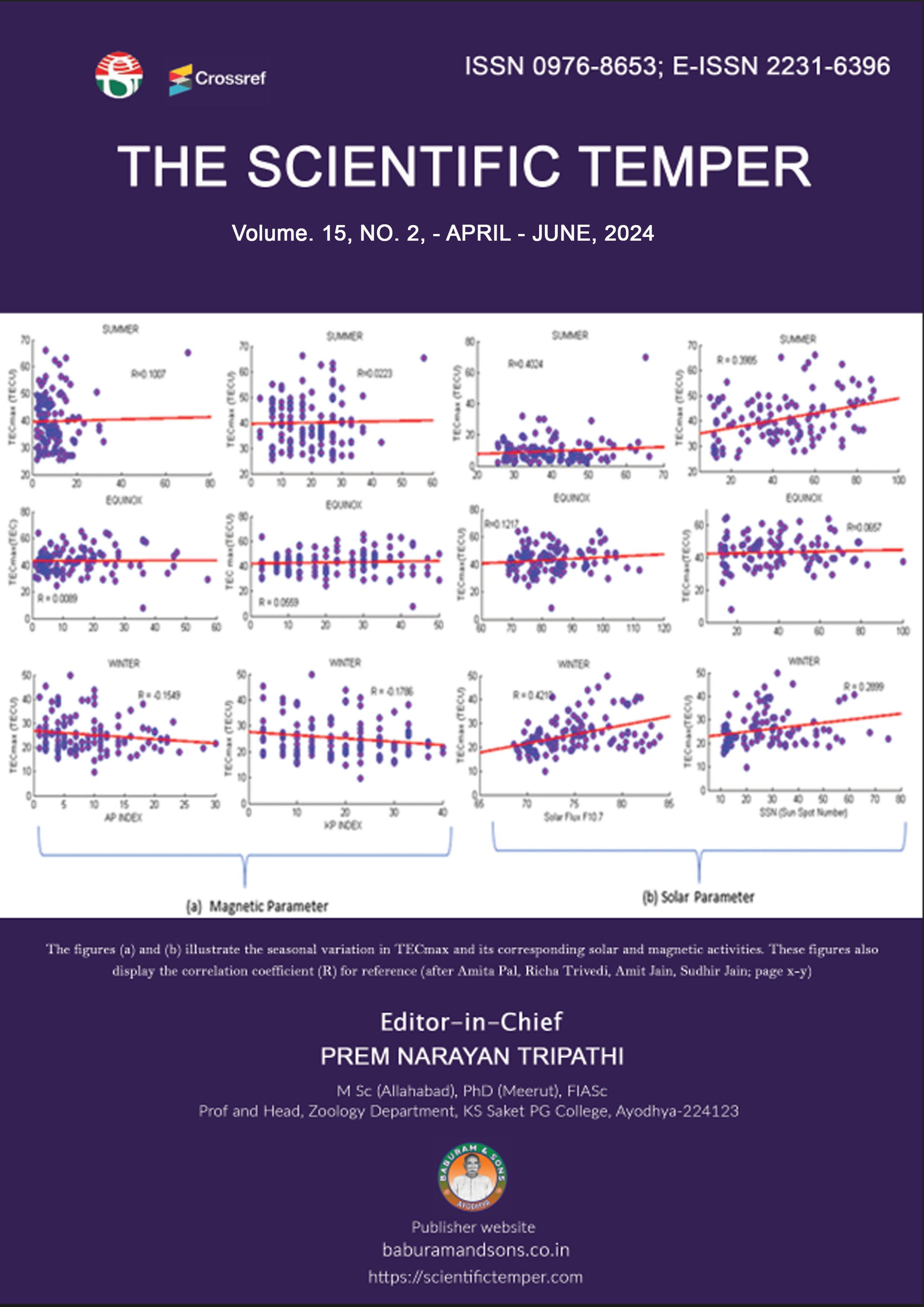
Diurnal and seasonal variation of GPS-TEC during a low solar activity period at EIA region (Bhopal)
Downloads
Published
DOI:
https://doi.org/10.58414/SCIENTIFICTEMPER.2024.15.2.16Keywords:
Keywords: Total Electron Content (TEC); Equatorial Ionization Anomaly (EIA); Global Positioning System (GPS); Solar Indices; Electron Electrojet (EEJ).Dimensions Badge
Issue
Section
License
Copyright (c) 2024 The Scientific Temper

This work is licensed under a Creative Commons Attribution-NonCommercial-ShareAlike 4.0 International License.
The ionosphere near the equatorial ionization anomaly crest region in the Indian ionospheric sector was studied from May 2016 to April 2017, a solar minimum period. Total electron content (TEC) recorded using the multiple frequency GPS receivers at Bhopal (23.2° N, 77.4° E & MLAT 14.2° N) is used for the study. The diurnal variation shows that the day minimum in TEC is attained around 06:00 hours LT, and the day maximum occurs at about 16:00 hours LT. A similar diurnal pattern was observed in all months across various seasons. During the period of study, it was observed that Seasonal variation of TEC was minimal in winter, whereas highest during equinox and summer months. The variation of TECmax with EEJ shows a positive correlation between the parameters for all the months. The highest correlation (0.8398) was observed in January 2017, while it was lowest (0.4004) in March 2017 and the results were compared with earlier observations, and a possible mechanism was discussed.Abstract
How to Cite
Downloads
Similar Articles
- Sampa Mondal, Baibaswata Bhattacharjee, Amelioration of the UV-blocking property of ZnO nanoparticles as an active sunscreen ingredient , The Scientific Temper: Vol. 15 No. 03 (2024): The Scientific Temper
- S. Srinithiya, K. Menaka, Optimized Hybrid Feature Selection Techniques for Detecting Iron Deficiency Anemia , The Scientific Temper: Vol. 16 No. 12 (2025): The Scientific Temper
- H. K. Pandey, H.S. Meena, Deen Dayal, M.S.M. Rawat, Z. Ahmed, ELEMENTAL COMPOSITION OF SOME ECONOMICALLY IMPORTANT LESS EXPLORED ALLIUM CULTIVARS OF WESTERN HIMALAYAN REGION , The Scientific Temper: Vol. 1 No. 01 (2010): The Scientific Temper
- Sony Kumari, Prashant Kumar, HYDROBIOLOGY AND PHYTOPLANKTON POPULATION IN CERTAIN PONDS OF NORTH BIHAR , The Scientific Temper: Vol. 9 No. 1&2 (2018): The Scientific Temper
- Nithya Raju , Shruthi Deivigarajan, Sindhuja Santhakumar, Sneha Balamurugan, Challenges encountered by healthcare professionals in monitoring adverse events due to medical devices-A review , The Scientific Temper: Vol. 14 No. 03 (2023): The Scientific Temper
- Suresh L. Chitragar, Measurement of agricultural productivity and levels of development in the Malaprabha river basin, Karnataka, India , The Scientific Temper: Vol. 15 No. 01 (2024): The Scientific Temper
- Brij M. Sharma, Parul Singhal, Neeraj Uniyal, Ram T. Mourya, Jai Sharma, Community based seasonally water quality testing of tributaries of Dehradun , The Scientific Temper: Vol. 15 No. 03 (2024): The Scientific Temper
- V. Baby Deepa, R. Jeya, Dynamic resource allocation with otpimization techniques for qos in cloud computing , The Scientific Temper: Vol. 15 No. spl-1 (2024): The Scientific Temper
- Ayalew Ali, Cheirnet Demissie, The effect of financial literacy on the medium scale enterprise performance: Evidence from Bench Sheko zone , The Scientific Temper: Vol. 16 No. 03 (2025): The Scientific Temper
- Y. Mohammed Iqbal, M. Mohamed Surputheen, S. Peerbasha, Swarm intelligence-driven HC2NN model for optimized COVID-19 detection using lung imaging , The Scientific Temper: Vol. 16 No. 03 (2025): The Scientific Temper
<< < 36 37 38 39 40 41 42 43 44 45 > >>
You may also start an advanced similarity search for this article.