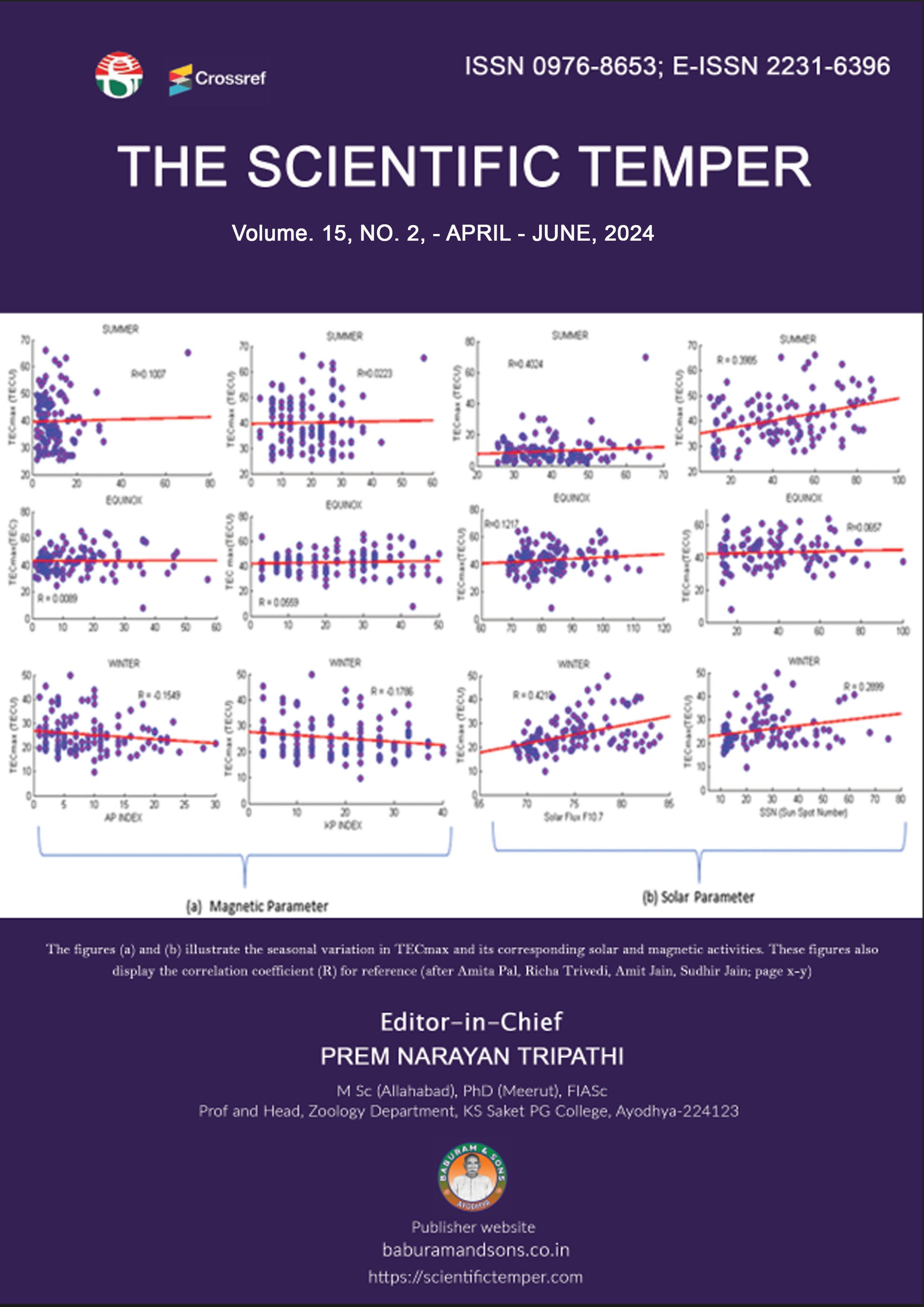
Diurnal and seasonal variation of GPS-TEC during a low solar activity period at EIA region (Bhopal)
Downloads
Published
DOI:
https://doi.org/10.58414/SCIENTIFICTEMPER.2024.15.2.16Keywords:
Keywords: Total Electron Content (TEC); Equatorial Ionization Anomaly (EIA); Global Positioning System (GPS); Solar Indices; Electron Electrojet (EEJ).Dimensions Badge
Issue
Section
License
Copyright (c) 2024 The Scientific Temper

This work is licensed under a Creative Commons Attribution-NonCommercial-ShareAlike 4.0 International License.
The ionosphere near the equatorial ionization anomaly crest region in the Indian ionospheric sector was studied from May 2016 to April 2017, a solar minimum period. Total electron content (TEC) recorded using the multiple frequency GPS receivers at Bhopal (23.2° N, 77.4° E & MLAT 14.2° N) is used for the study. The diurnal variation shows that the day minimum in TEC is attained around 06:00 hours LT, and the day maximum occurs at about 16:00 hours LT. A similar diurnal pattern was observed in all months across various seasons. During the period of study, it was observed that Seasonal variation of TEC was minimal in winter, whereas highest during equinox and summer months. The variation of TECmax with EEJ shows a positive correlation between the parameters for all the months. The highest correlation (0.8398) was observed in January 2017, while it was lowest (0.4004) in March 2017 and the results were compared with earlier observations, and a possible mechanism was discussed.Abstract
How to Cite
Downloads
Similar Articles
- K. R. R. Prakash, Kishore Kunal, Designing information systems for business administration through human and computer interaction , The Scientific Temper: Vol. 15 No. 02 (2024): The Scientific Temper
- Theophilus Deenadayal, Tarun Jain, Floristic composition in Paramananda Devara Gudda A sacred grove at Lingadahalli Village Devadurga Taluk Raichur District Karnataka, India , The Scientific Temper: Vol. 15 No. 04 (2024): The Scientific Temper
- N. Yogalakshmi, Awareness on environmental issues and sustainable practices among college students - with special reference to Chennai city region , The Scientific Temper: Vol. 16 No. Spl-2 (2025): The Scientific Temper
- K. John Bosco, A. S. Nageswaran, Impact of Isolated Endurance and Concurrent Training on Aerobic Capacity (VO2max) and Speed Performance in field hockey players , The Scientific Temper: Vol. 17 No. 04 (2026): The Scientific Temper
- ATANU BHATTACHARYYA, P. S. DATTA, ASIM BHAUMIK, SHASHIDHAR VIRAKTAMATH, MORSHED U. CHOWDHURY, RAJENDRA KUMAR ISAAC, TINY DEVICES- NANO - THE EMERGING WORLD TECHNOLOGY , The Scientific Temper: Vol. 2 No. 1&2 (2011): The Scientific Temper
- Neeru Garg, B. R. Jaipal, Food Compositions of the Indian Fox (Vulpes bengalensis) in the Desert Region of Rajasthan, India , The Scientific Temper: Vol. 11 No. 1&2 (2020): The Scientific Temper
- Binay Kumar Mahto, Rakesh Patel, Rajendra Bapna, Ajay Kumar Shukla, Development and Standardization of a Poly Herbal Formulation , The Scientific Temper: Vol. 13 No. 02 (2022): The Scientific Temper
- Sadanand Maurya, Manikant Tripathi, Karunesh Kumar Tiwari, Awadhesh Kumar Shukla, Analyses of water quality using different physico-chemical parameters: A study of Saryu river , The Scientific Temper: Vol. 14 No. 03 (2023): The Scientific Temper
- Kalpana Deshmukh, Aparna Dighe, Harshal Raje, Impact of mindfulness-based programs on reducing stress and enhancing academic performance in college students , The Scientific Temper: Vol. 14 No. 04 (2023): The Scientific Temper
- V. Selvi, T. S. Poornappriya, R. Balasubramani, Cloud computing research productivity and collaboration: A scientometric perspective , The Scientific Temper: Vol. 15 No. spl-1 (2024): The Scientific Temper
<< < 30 31 32 33 34 35 36 37 38 39 > >>
You may also start an advanced similarity search for this article.